As organizations worldwide prepare for this next evolution in customer service, Landis Technologies stands at the forefront as an early adopter of this technology. Microsoft has announced general availability of the Teams Phone extensibility API, marking a pivotal moment for contact center technology.
Landis Leads the Charge in Advanced Contact Center Innovation
Microsoft Collaboration Drives Industry Leadership
Landis Technologies’ leadership in the Teams Phone Extensibility space is the result of years of collaboration with Microsoft. Our collaboration includes:
Assistance With the Development of Teams Phone Extensibility APIs: Our team has worked directly with Microsoft engineers to give feedback on the design and test the client APIs, helping to shape the final specifications.
Microsoft Teams Phone Extensibility Launch Partner: As one of Microsoft’s original launch partners, Landis gained early access to extensibility frameworks that form the foundation of the Teams Phone extensibility.
Among the First Unify integration model – Contact Center Solutions Certified for Microsoft Teams: Among the vanguard of solutions Certified for Microsoft Teams, Landis Contact Center achieved Unify certification ahead of general availability, providing clients with immediate access to these advanced capabilities.
Preview Release Leadership: Landis was one of the first vendor to release a Unify-based contact center in preview, giving customers early access to next-generation features.
Albert Kooiman, General Manager, Partner Engineering and Customer Experiences at Microsoft says:
“Landis is helping set the pace for contact center innovation and integration with Microsoft Teams. By building on the Teams Unify integration model, Landis enables customers to extend Teams Phone directly into the contact center and take advantage of advanced capabilities such as smart routing, AI-driven agent support, and rich engagement within Teams.”
What the Unify Integration Model Means for Contact Centers
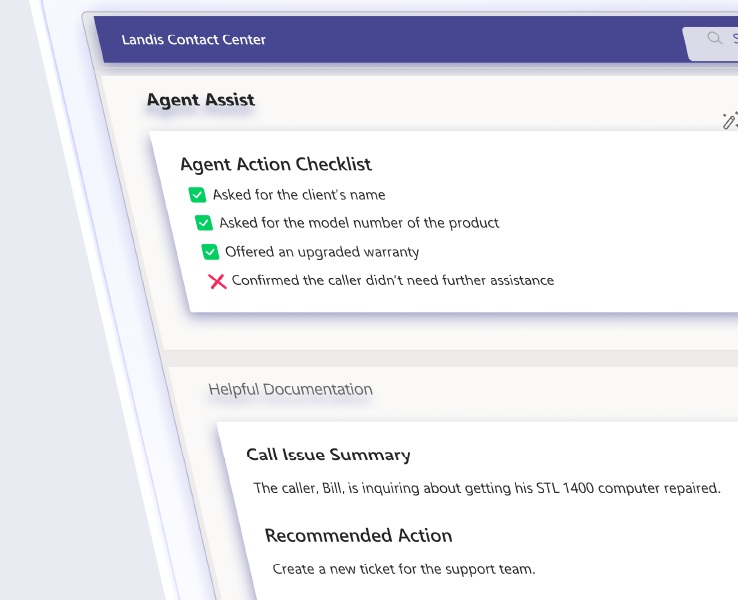
The Teams Unify integration model is the underlying model for Teams Phone extensibility enabling solution providers to embed native Teams experiences into their applications. Built on Microsoft Azure Communication Services, the Teams Unify integration model represents Microsoft’s most sophisticated contact center integration approach. Unlike previous models, the Teams Unify integration model treats artificial intelligence as a “first-class citizen,” providing the technical framework for intelligent virtual agents (IVAs) and AI-enhanced human agents.
The Landis Advantage: Two-Engine Model for Seamless Transformation
What sets Landis apart is our unique “2-engine model” that bridges present needs with future capabilities: and Cisco replacement functionality with enterprise-grade reliability.
Unify integration Model (Future-Ready): Advanced AI capabilities and intelligent virtual agents that represent the next evolution of customer service, available as organizations are ready to adopt them.
Both integrations, or “engines,” can be used to power the same contact center, or even just a part of it, as it works best for each scenario.
“Intelligent Virtual Agents are a great way to start improving customer experience with Landis and Unify. And with the unique Landis ‘2-engine model,’ Microsoft Teams organizations have a seamless bridge to the future of customer experience.”
Matt Landis
Intelligent Virtual Agents: The New Frontier
The AI capabilities of the Unify integration model enable intelligent virtual agents that can handle complex, multi-step interactions previously requiring human intervention. Key advances include:
Enhanced Voice Recognition: More accurate speech-to-text capabilities help IVAs understand complex requests, regional accents, and conversational patterns.
Advanced Natural Language Processing: IVAs engage in contextual conversations, understanding intent rather than just keywords.
Seamless Escalation With Full Context: When human intervention is needed, transfers include complete interaction history, eliminating customer frustration from repeating information.
The Contact Center Transformation Timeline
While the industry often focuses on “AI augmenting human agents,” the technical capabilities enabled by the Unify integration model may start a larger shift. Organizations that begin building intelligent virtual agent capabilities today will be best positioned as AI handles an increasing share of customer interactions.
The contact centers that thrive in the next three years will be those that deploy AI as a primary customer service channel, not just a supplementary tool. Unify provides the technical foundation for this change within the Microsoft ecosystem most organizations already rely on.