Every customer call represents an opportunity to build meaningful connections and solve problems quickly. But when callers face long wait times or multiple transfers, these opportunities vanish. For IT leaders, intelligent call routing is the perfect solution for modernizing infrastructure and improving service metrics.
What is Intelligent Call Routing?
Intelligent call routing directs each call to the most appropriate destination based on multiple factors. Unlike basic queues, intelligent routing can analyze caller needs, agent skills, and other data to make smart decisions about who should handle each interaction.
How Does Intelligent Call Routing Reduce Costs?
- Faster resolutions and higher satisfaction metrics
- More efficient operations
- Optimized cloud investments
- Reduced on-premises infrastructure
5 Intelligent Call Routing Methods
Microsoft Teams provides a powerful foundation for contact center operations. With Landis Contact Center, IT leaders can implement these five intelligent routing strategies.
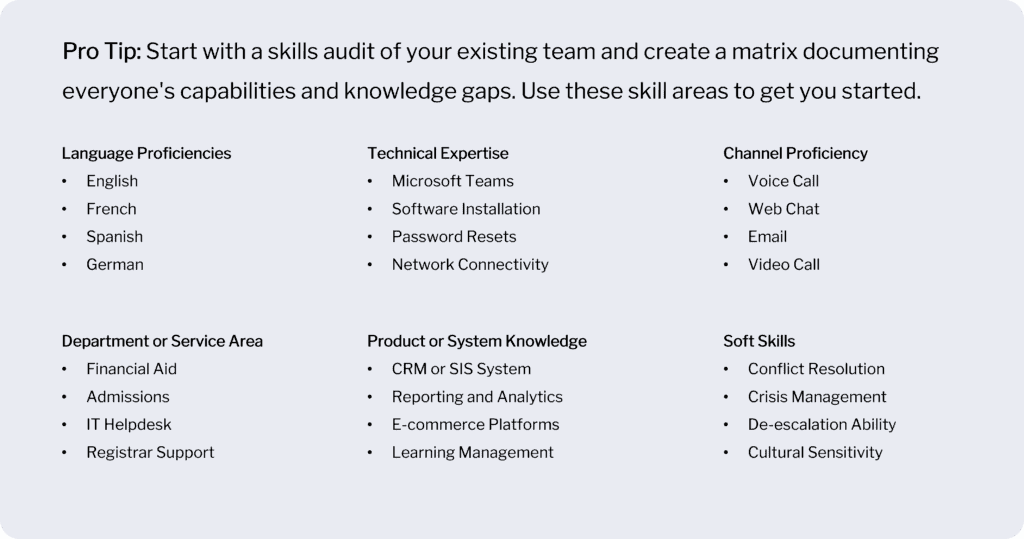
1. Skills-Based Routing – Are calls reaching agents with the appropriate skills?
What it is: Directs calls to agents with the expertise needed to handle the caller’s specific issue.
How it works in Landis Contact Center: Administrators define skills and assign skill levels to agents. When a call comes in, the system automatically routes it to the most qualified available agent.
Benefits
- Reduces or eliminates transfers between departments
- Improves first-contact resolution rates
- Decreases handle times
- Enhances customer satisfaction
2. Teams Presence-Based Routing – Are calls being routed to agents who are actually available?
What it is: Uses Microsoft Teams presence status to make sure calls only go to agents who are available.
How it works in Landis Contact Center: The system checks agent availability via Teams presence which is made possible through API integration.
Benefits
- Maximizes your Microsoft Teams infrastructure investment
- Prevents abandoned calls and improves customer satisfaction
- Reduces resource waste by optimizing agent utilization
- Increases system efficiency through better workload distribution
Next level: Landis Contact Center adds to Teams Presence routing with RONA (Reroute On No Answer). When a call is directed to an agent who has left their desk but forgotten to sign out and is still marked ‘available,’ the system will put them into the RONA status after the first missed alert, preventing more calls from being routed to the unavailable agent.
3. Queue-Based Routing Options – How are wait times being optimized across queues?
What it is: Various intelligent routing strategies are available for different needs. These can be modified on demand or changed for individual queues.
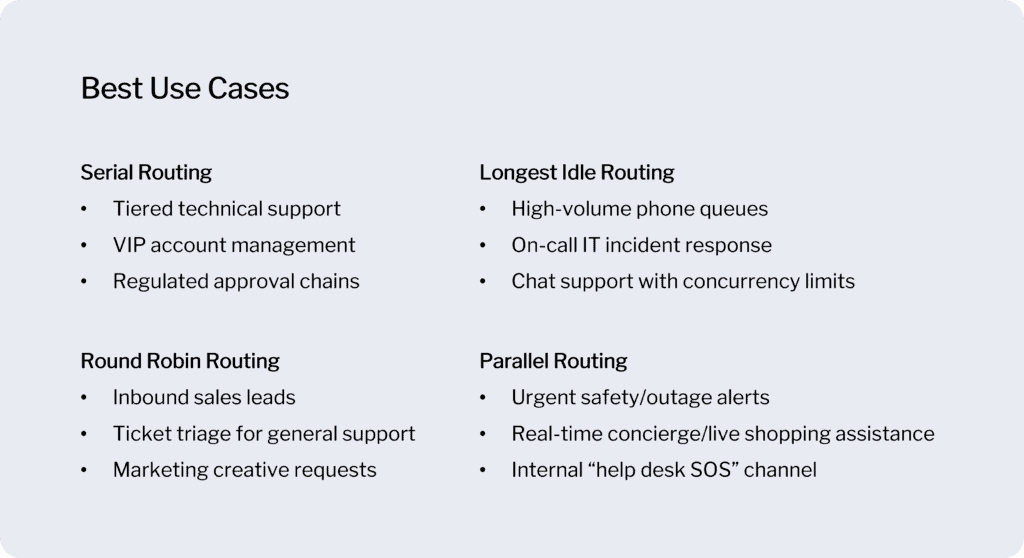
Intelligent routing options in Landis Contact Center include:
- Serial: Follows a predefined agent order
- Round Robin: Similar to serial, but rotates through the predefined order
- Longest Idle: Sends calls to the agent who has not received a call for the longest
- Parallel: Rings multiple agents simultaneously
Benefits
- Flexibility to adapt routing to different business needs
- Ability to balance workloads across your support infrastructure
- Options to implement routing based on business priorities
- Centralized management within the Teams environment
4. Data-Driven Routing – Are calls being routed according to caller status or history?
What it is: Uses external data and/or real-time conditions to make routing decisions.
How it works in Landis Contact Center: Using regex capabilities and data dips, the system can extract information from caller attributes (e.g. number or location) or external systems (e.g. CRM integrated with the contact center).
Benefits
- Seamless integration with existing Microsoft and third-party systems
- Customizable logic for various business requirements
5. AI-Enhanced Routing & Smarter IVRs – When should AI handle routing decisions?
What it is: Uses artificial intelligence to analyze speech and make decisions based on how callers state their needs in natural language.
How it works in Landis Contact Center: The IVR Designer includes AI blocks that perform basic natural language classification directly within the IVR. No Power Automate or external tools are needed. Using variables captured from Voice Input blocks, callers can ask open-ended questions like, “What’s this call about?” and let AI classify the response and route accordingly.
Benefits
- More conversational IVRs that reduce call abandonment and increase first-call resolution.
- Improved routing accuracy based on caller responses.
How Can You Tell if the Call Routing Strategy is Working?
To evaluate how valuable intelligent call routing is for you, focus on these KPIs.
Support Team Metrics:
- First-call resolution rate improvement
- Average handle time reduction
- Agent utilization improvement
- Callback and escalation reduction
Customer Experience Metrics:
- Customer satisfaction scores
- Net Promoter Score increases
- Abandonment rate reduction
- Self-service adoption rates increase
Landis Contact Center provides hundreds of reporting tools that track these call center IVR analytics, giving the insights needed to demonstrate ROI.
The process runs in three stages. First, the system gathers caller data such as phone number, location, CRM history, and IVR input. Second, it analyzes that data against routing rules and agent skills. Third, it routes the call to the most qualified available agent, or places it in a queue if no agent is immediately available.
A standard IVR asks callers to press a number and routes them to a queue. Intelligent routing lets them simply say what they need. The system listens, understands the request, and figures out the fastest way to solve it.
Skills-based routing directs each call to the agent whose expertise best matches the caller’s need. In Landis Contact Center, administrators define skills and assign proficiency levels to agents; the system handles the matching automatically.
Teams provides foundational call queue and auto attendant features, including attendant routing, serial routing, and round robin. Auto attendants route calls immediately upon answering or redirect callers based on dial options. However, native Teams lacks skills-based routing, presence-aware routing with RONA, CRM data dips, and AI-powered IVR classification. Landis Contact Center adds those capabilities directly inside Teams.
RONA stands for Reroute On No Answer. When an agent forgets to update their presence status to “away” and a call is sent to them, RONA automatically moves that agent to an unavailable state after the first missed alert, which prevents subsequent calls from piling up.
Frequently Asked Questions About Intelligent Call Routing
Next Steps to Intelligent Call Routing
Ready to see how intelligent call routing strategies can transform your contact center operations while advancing your strategic IT objectives? Book a demo of Landis Contact Center for Microsoft Teams today.