
By Dominic Kent
Dominic Kent is an independent writer who specializes in unified communications and contact center technology. He runs UC Marketing Ltd, a consultancy dedicated to helping technology companies translate complex technology products into compelling stories and educational content. His projects often involve well-researched guides that speaks to IT leaders and business stakeholders alike.
Table of contents
- Landis Contact Center vs CentrePal at a Glance
- What Is Landis Contact Center?
- What Is CentrePal?
- Landis Contact Center vs CentrePal: Feature Comparison
- What Customers Say About Landis Contact Center and CentrePal
- Pros and Cons
- Which Contact Center Should You Choose?
- Final Verdict
- See Landis Contact Center in Action
Choosing the right Microsoft Teams contact center isn’t just about features. But when comparing Landis Contact Center and CentrePal, one difference stands out immediately: the digital channels each vendor publicly supports.
Rather than bury the lede, let’s start there.
According to CentrePal’s website as of July 2026, the platform supports:
- Voice
- Web chat
Landis Contact Center supports:
- Voice
- Web chat
- SMS
- Facebook Messenger
- Email (coming soon)
If your customer service strategy extends beyond traditional voice and email, that difference could significantly influence your shortlist. The rest of this comparison explores how the two platforms differ across Microsoft Teams integration, AI, reporting, pricing, and customer reviews.
Landis Contact Center vs CentrePal at a Glance
| Feature | Landis Contact Center | CentrePal |
|---|---|---|
| Microsoft Teams certification | Extend + Unify | Extend + Unify |
| Voice | ✓ | ✓ |
| Digital channels | Voice, web chat, SMS, WhatsApp, Facebook Messenger, email (coming soon) | Voice, email, web chat |
| AI | Conversational AI agents, Agent Assist, AI summaries, intelligent routing, sentiment analysis, live coaching, AI analytics | AI-powered routing, intent detection, sentiment analysis, live transcription, AI summaries, conversational AI |
| Reporting | Real-time dashboards, historical reporting, transcript reporting, IVR reporting, scheduled reports, webhooks, RBAC, Excel exports | Real-time dashboards, analytics, KPI reporting, Power BI integration |
| CRM integrations | Dynamics 365, Salesforce, HubSpot, Zendesk, ServiceNow, Freshworks, Jira, Zoho CRM, SugarCRM, Monday.com, Power Platform, OpenAI, API | Dynamics 365, Range of non-listed CRM integrations, API access |
| Workforce management | Third-party integration with Peopleware | Direct connection to Microsoft Shifts |
| Deployment | Self-service or professional implementation | Cloud-native deployment hosted in Azure |
| Pricing | Public pricing from $75/user/month | Microsoft Marketplace indicates $780/user/year |
| Best suited for | Teams-first organizations looking for transparent pricing, broad digital channel support, and extensive integrations | Teams-first organizations prioritizing simple administration and basic functionality |
What Is Landis Contact Center?
Landis Contact Center is a Microsoft Teams-native contact center built exclusively for Microsoft Teams. Rather than adapting a traditional contact center platform, it’s designed to extend Teams with enterprise-grade customer service capabilities while keeping agents and supervisors inside the Microsoft ecosystem.
The platform is certified under Microsoft’s Extend and Unify integration models, allowing you to add contact center functionality without introducing another desktop application. Agents can manage customer interactions directly within Teams, while supervisors have access to reporting, AI, quality management, and administration from a single interface.
A Long History of Building for Microsoft
One of Landis’ biggest differentiators is its long-standing investment in Microsoft’s communications platforms.
From the beginning, Landis has built software that integrates deeply with Microsoft technologies, evolving alongside Microsoft’s unified communications strategy from Lync to Skype for Business and now Teams.
Rather than entering the Teams contact center market after Teams became mainstream, Landis had already spent years developing Microsoft-integrated communications software. That experience has enabled the company to evolve alongside Microsoft’s changing certification models and product roadmap.
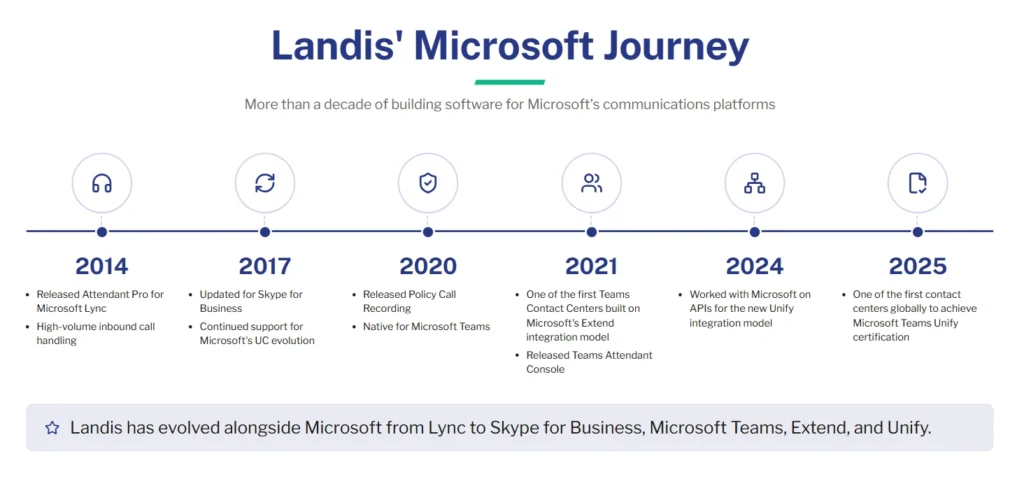
Microsoft Timeline
- 2014: Released Attendant Pro for Microsoft Lync, helping organizations manage high volumes of inbound calls.
- 2017: Updated Attendant Pro for Skype for Business, allowing customers to continue supporting Microsoft’s evolving communications platform.
- 2020: Released Policy Call Recording for Teams, expanding its Teams portfolio.
- 2021: Released one of the first Teams contact center solutions built on Microsoft’s Extend integration model, followed shortly by its Teams Attendant Console.
- 2024: Worked closely with Microsoft to help develop APIs for the new Unify integration model.
- 2025: Became one of the first contact center vendors to achieve Teams Unify certification.
Landis supports voice alongside digital channels including web chat, SMS, WhatsApp, and Facebook Messenger, with email currently on the product roadmap.
The platform also includes:
- Conversational AI agents
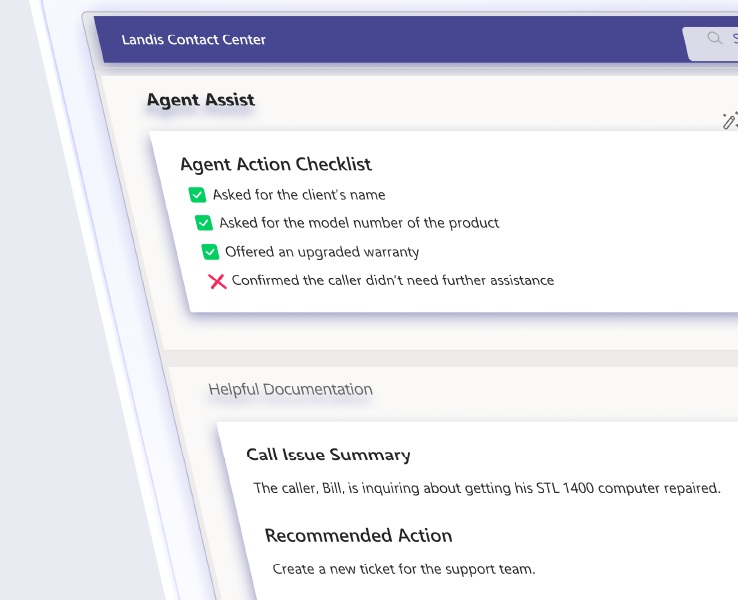
- Agent Assist
- AI-generated summaries
- Intelligent routing
- Sentiment analysis
- Live coaching
- AI analytics
Beyond customer engagement, Landis integrates with a broad range of business applications, including:
- Microsoft Dynamics 365
- Salesforce
- HubSpot
- Zendesk
- ServiceNow
- Freshworks
- Jira
- Zoho CRM
- SugarCRM
- Monday.com
- Microsoft Power Platform
- OpenAI
- Additional systems through its API
What Is CentrePal?
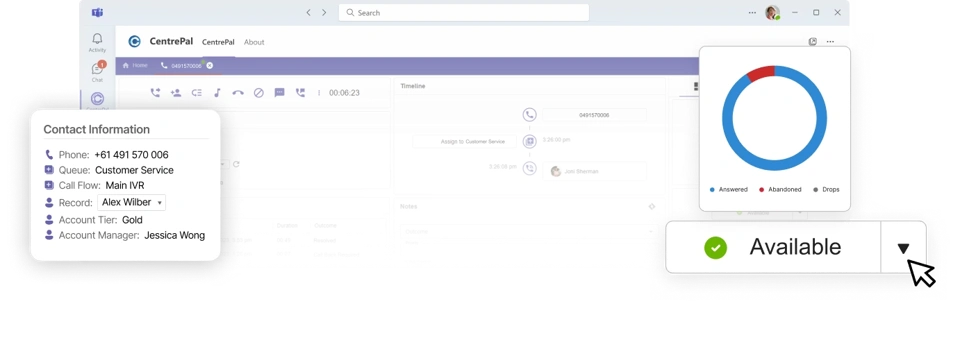
CentrePal is a Microsoft Teams-native contact center designed to help organizations manage customer interactions from within Teams.
Headquartered in Australia, CentrePal focuses exclusively on Microsoft-based customer engagement solutions. Like Landis, the platform is certified under Microsoft’s Extend and Unify integration models, allowing organizations to extend Teams with enterprise contact center functionality while maintaining a familiar experience for agents and supervisors.
According to CentrePal’s website, the platform supports the following customer channels:
- Voice
- Web chat
The platform also includes:
- AI-powered routing
- Intent detection
- Sentiment analysis
- Live transcription
- AI-generated summaries
- Conversational AI
- Real-time supervisor insights
CentrePal also provides:
- Native workforce management
- Microsoft Shifts integration
- Power BI integration
- CRM and service management integrations
- Open APIs for additional integrations
Landis Contact Center vs CentrePal: Feature Comparison
On paper, Landis Contact Center and CentrePal share many similarities. Both are Teams-native contact centers certified under Microsoft’s Extend and Unify integration models, and both keep agents working within Teams rather than switching between separate desktop applications.
The differences become clearer when you compare the breadth of customer channels, AI capabilities, reporting, integrations, and workforce management features. Here’s how the two platforms compare.
Customer Channels
One of the clearest differences between Landis Contact Center and CentrePal is the range of customer communication channels each platform publicly supports.
Landis is designed for organizations that want to manage customer conversations across multiple channels from a single interface. In addition to voice, it supports web chat, SMS, WhatsApp, and Facebook Messenger, with email listed as coming soon. This allows agents to manage conversations from multiple channels without leaving Teams.
CentrePal’s website currently documents support for voice, email, and web chat. For organizations that primarily handle traditional customer service interactions through those channels, this may be sufficient. However, businesses looking to expand into messaging platforms may need to confirm future roadmap plans or available integrations with CentrePal.
AI Capabilities
Both Landis Contact Center and CentrePal have invested heavily in AI, helping organizations improve agent productivity and automate customer interactions.
Landis includes conversational AI agents, Agent Assist, AI-generated conversation summaries, intelligent routing, sentiment analysis, live coaching, and AI analytics. These capabilities are designed to reduce administrative work for agents while providing supervisors with greater visibility into customer interactions and agent performance.
CentrePal also offers a comprehensive AI feature set, including conversational AI, AI-powered routing, intent detection, sentiment analysis, live transcription, AI-generated summaries, and real-time supervisor insights. Like Landis, the platform focuses on improving both customer experience and agent efficiency through AI.
Overall, there is significant overlap between the two platforms. Both provide modern AI capabilities that extend beyond simple chatbots, although the specific implementation and user experience may differ.
Read More: 6 Practical AI Use Cases in Contact Centers for Microsoft Teams
Reporting and Analytics
Both platforms provide reporting tools that help supervisors monitor contact center performance, although their published capabilities differ.
Landis offers real-time dashboards alongside historical reporting, transcript reporting, IVR reporting, scheduled reports, Excel exports, webhook support, and role-based access controls. These features provide operational visibility while allowing organizations to integrate reporting data into wider business processes.
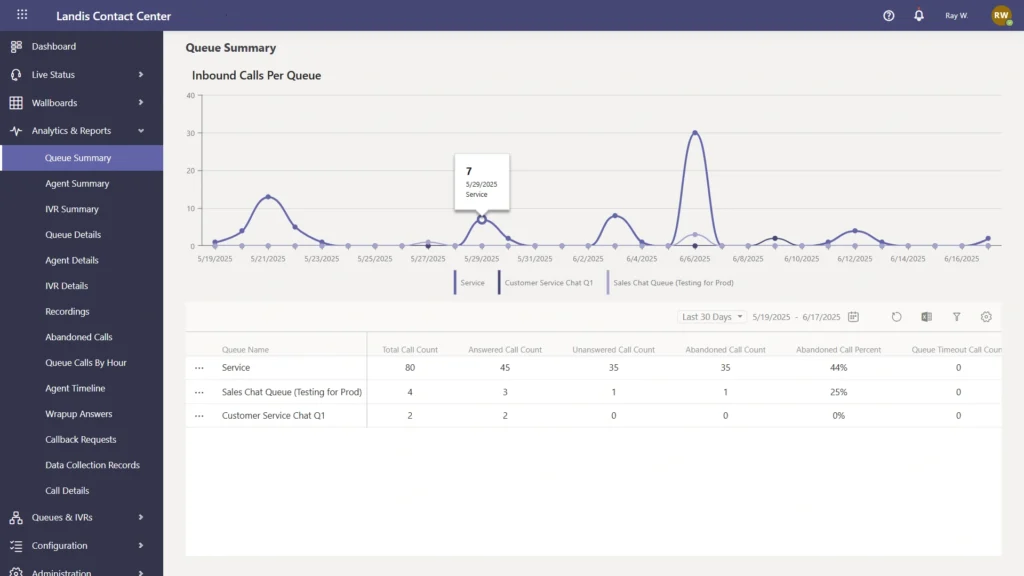
CentrePal provides real-time dashboards, analytics, KPI reporting, and integration with Microsoft Power BI. Organizations already using Power BI may find this particularly valuable for combining contact center data with reporting from other Microsoft business applications.
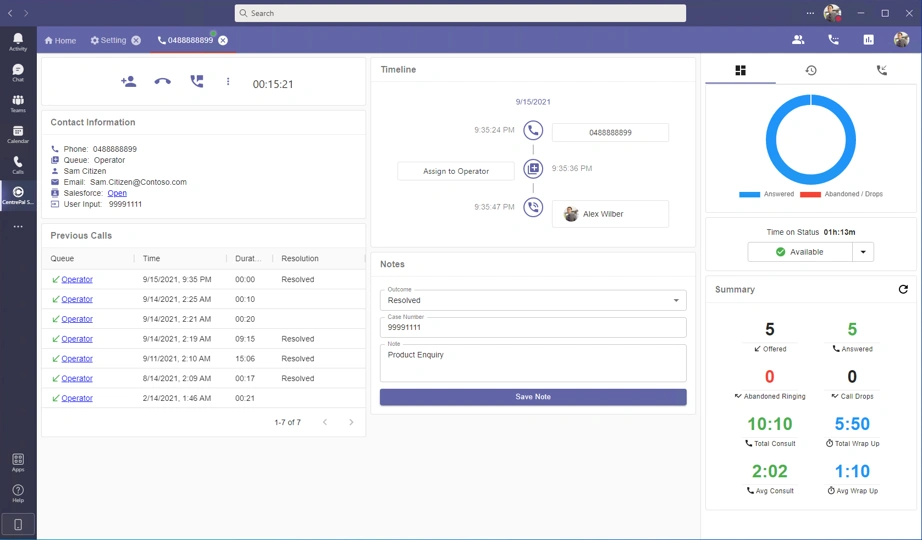
Both platforms provide the core reporting capabilities expected from an enterprise contact center, with Landis publicly documenting a broader range of built-in reporting features.
CRM and Business Integrations
Integrations often play a significant role in determining how well a contact center fits within your existing technology stack.
Landis publishes a broad range of supported integrations, including:
- Microsoft Dynamics 365
- Salesforce
- HubSpot
- Zendesk
- ServiceNow
- Freshworks
- Jira
- Zoho CRM
- SugarCRM
- Monday.com
- Microsoft Power Platform
- OpenAI
- Additional integrations through its API
CentrePal also integrates with CRM and service management platforms while providing open APIs for custom integrations. Although the company publicly documents fewer named integrations, its API allows organizations to connect the platform with existing business systems where required.
If your organization depends on a large number of out-of-the-box integrations, Landis currently provides greater visibility into its supported ecosystem.
Workforce Management
The two platforms take different approaches to workforce management.
CentrePal includes native workforce management capabilities with integration into Microsoft Shifts. This allows supervisors to manage staffing, scheduling, and workforce planning within the Microsoft ecosystem while helping align staffing levels with contact center demand.
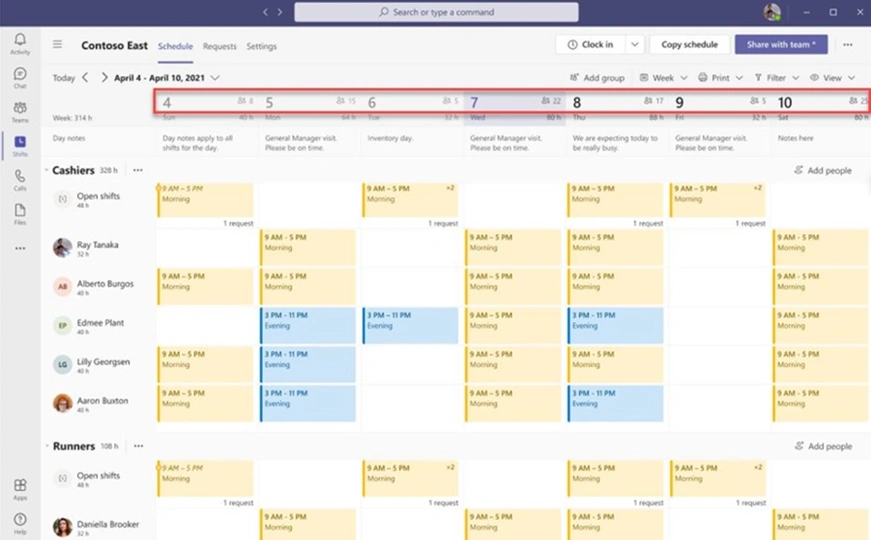
Landis supports workforce management through third-party integrations, allowing organizations to connect with existing workforce management solutions where required.
The better approach depends on your existing environment. Organizations looking for integrated workforce management within Teams may prefer CentrePal’s native capabilities, while those already using dedicated workforce management software may appreciate Landis’ integration approach.
Deployment and Administration
Both platforms are designed as cloud-based contact centers for Teams, but they differ in how deployment is positioned.
Landis offers both self-service deployment and implementation services delivered by its own team, allowing organizations to choose the level of support that best fits their internal resources and expertise.
CentrePal is delivered as a cloud-native platform hosted in Microsoft Azure and is designed to integrate directly with Teams using Microsoft’s certified APIs.
For most organizations, deployment is unlikely to be the deciding factor. Instead, the choice is more likely to come down to channel support, integrations, AI capabilities, and how well each platform aligns with your existing Microsoft environment.
Landis Contact Center vs CentrePal Pricing
Both Landis Contact Center and CentrePal publish transparent pricing, making it easier to estimate licensing costs before engaging with sales.
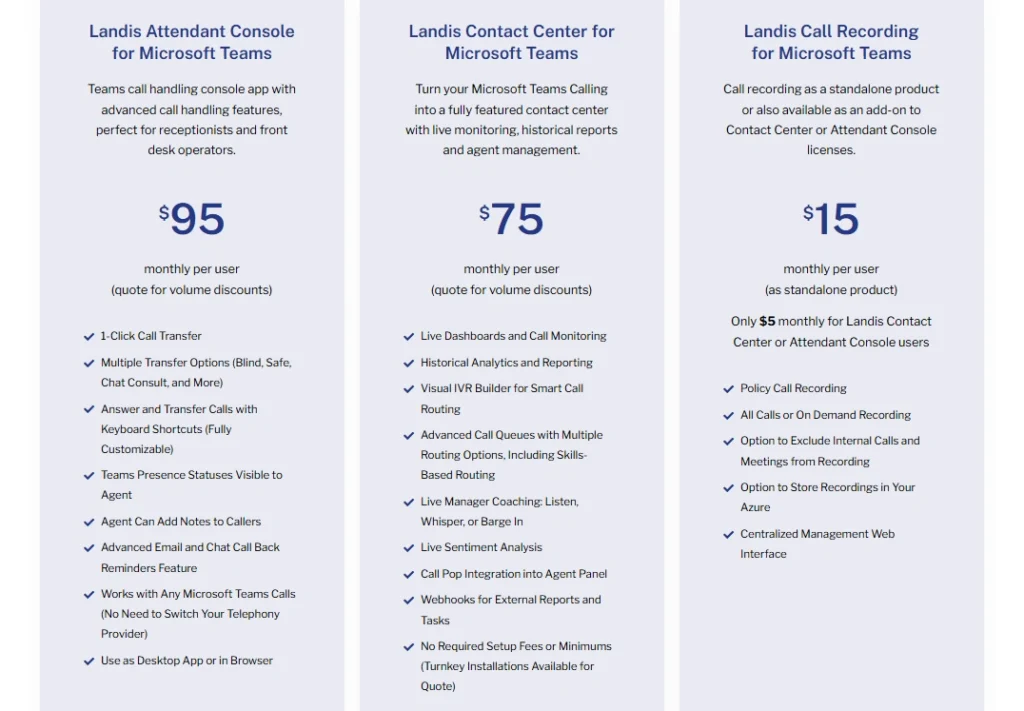
Landis pricing starts at $75 per user/month, which is equivalent to $900 per user/year.
You can also see clear pricing for standalone attendant console and call recording licenses where needed.
CentrePal publishes an annual subscription through the Microsoft commercial marketplace at $780 per user/year. The Marketplace listing also includes an Upcoming price change notice, indicating that pricing is scheduled to increase, although the new price has not yet taken effect.
| Feature | Landis Contact Center | CentrePal |
|---|---|---|
| Starting price | $75/user/month | $780/user/year |
| Annual equivalent | $900/user/year | $780/user/year |
| Public pricing | Yes | Yes |
| Upcoming published price change | No | Yes |
Based on the currently published pricing, CentrePal has the lower entry-level subscription cost. However, software licensing is only one part of the overall investment. You should also consider implementation services, supported communication channels, AI capabilities, integrations, support, and any additional Microsoft licensing required for your deployment.
What Customers Say About Landis Contact Center and CentrePal
Features and pricing only tell part of the story. Customer reviews provide valuable insight into what it’s actually like to deploy and manage each platform.
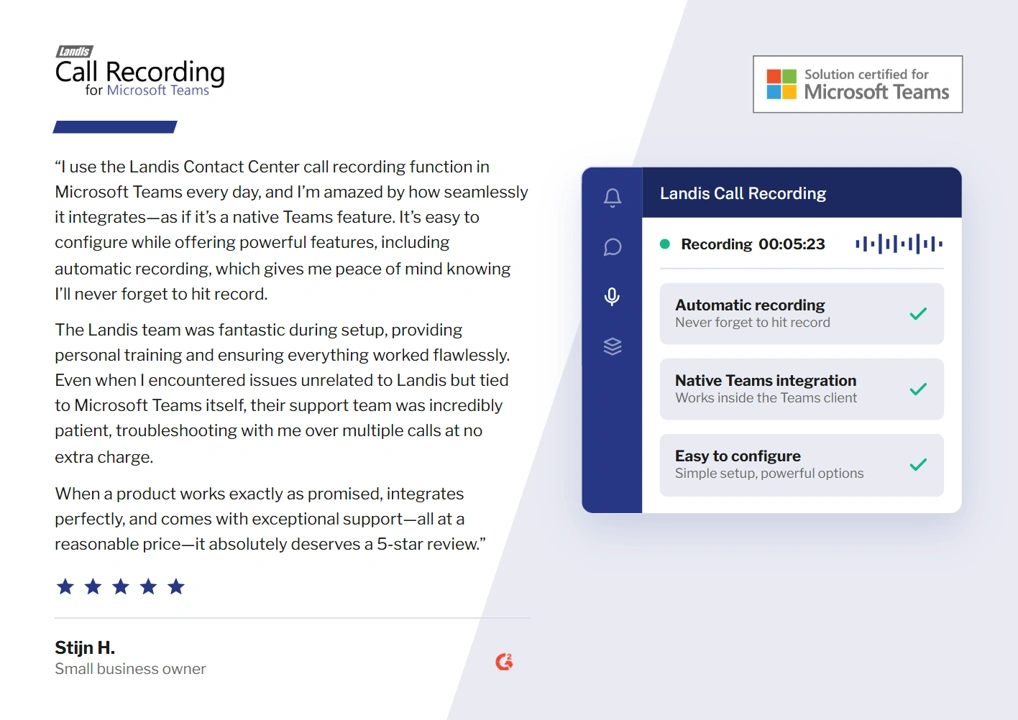
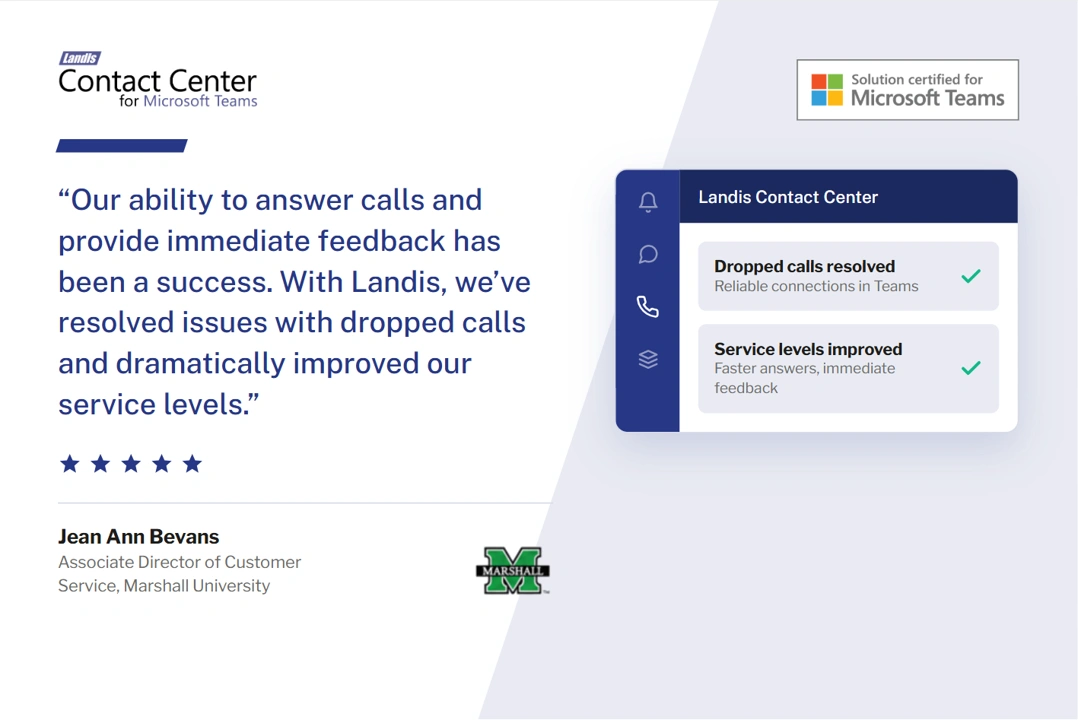
Landis has received positive feedback for its Microsoft expertise, responsive support, and ability to deliver enterprise contact center functionality within Teams. Customers frequently highlight the platform’s flexibility and the quality of the implementation experience.
CentrePal customers often praise the platform’s ease of administration and its seamless integration with Teams. One customer, Acer, highlighted how the platform has simplified day-to-day management:
“The fact that CentrePal makes it so easy for contact center management to make changes with confidence, without needing to raise a ticket with our IT team, has just made everything a lot more agile.”
This reflects one of CentrePal’s key strengths: giving contact center administrators greater control without relying heavily on IT teams for routine changes.
As with any enterprise software purchase, customer reviews should be considered alongside your own requirements, technical environment, and implementation goals. Speaking with existing customers or requesting product demonstrations can provide additional confidence before making a decision.
Pros and Cons
Landis Contact Center Pros
- Built on decades of experience delivering enterprise contact center solutions for Microsoft environments.
- Proven deployment experience with large enterprise organizations, including Helly Hansen and 1,000+ happy customers.
- Supports more documented communication channels, including voice, web chat, SMS, WhatsApp, and Facebook Messenger.
- Extensive published CRM and business application integrations.
- Flexible deployment options, including self-service and professional implementation.
- Certified under both the Microsoft Teams Extend and Unify integration models.
Landis Contact Center Cons
- Email is on the roadmap for Q4 2026/Q1 2027.
- Organizations with relatively simple contact center requirements may not need the breadth of channels and integrations the platform provides.
CentrePal Pros
- Built exclusively for Microsoft Teams, with agents working directly within Teams.
- Certified under both the Microsoft Teams Extend and Unify integration models.
- Native workforce management with Microsoft Shifts integration.
- Cloud-native deployment on Microsoft Azure.
- Customers praise its ease of administration and ability to reduce reliance on IT for routine configuration changes.
CentrePal Cons
- Public documentation currently lists fewer supported digital channels than Landis.
- Fewer named CRM and business application integrations are publicly documented.
- Less publicly available product documentation makes it more difficult to evaluate the platform’s capabilities before engaging with the vendor.
- Microsoft Marketplace indicates an upcoming price change.
Which Contact Center Should You Choose?
Both Landis Contact Center and CentrePal are certified Microsoft Teams contact centers under the Extend and Unify integration models. They enable agents to work directly within Teams and provide AI capabilities designed to improve customer service and agent productivity.
The right choice depends on your organization’s priorities, deployment requirements, and long-term customer engagement strategy.
Choose Landis Contact Center if you:
- Need to support customers across a wider range of communication channels, including SMS, WhatsApp, and Facebook Messenger.
- Require a platform with proven enterprise deployment experience across large organizations.
- Value the flexibility of self-service deployment or a fully managed implementation.
- Prefer a vendor with decades of experience delivering Microsoft contact center solutions.
Choose CentrePal if you:
- Primarily handle customer interactions through voice, email, and web chat.
- Want native workforce management with Microsoft Shifts integration.
- Prefer a platform with a lower published entry price.
Ultimately, both platforms are capable Microsoft Teams contact centers, but they are positioned differently. Landis emphasizes enterprise-scale deployments, broader omnichannel engagement, and deployment flexibility. CentrePal focuses on a streamlined Teams-native experience with native workforce management and a lower published entry price.
The best choice depends on how your organization communicates with customers today, how you expect those channels to evolve, and the level of functionality, scalability, and implementation support you require from your contact center platform.
Final Verdict
Landis Contact Center and CentrePal are both certified Microsoft Teams contact centers that enable organizations to deliver customer service directly within Teams. Both support Microsoft’s Extend and Unify integration models, offer AI-powered capabilities, and are designed to replace traditional contact center platforms with a native Teams experience.
The differences become clearer when you look beyond certification.
Landis Contact Center:
- Broader range of documented digital channels, including SMS, WhatsApp, and Facebook Messenger.
- Wider ecosystem of published CRM and business application integrations.
- Flexible deployment options, including self-service and professional implementation.
- Proven track record of enterprise deployments across globally recognized organizations.
- Decades of experience delivering Microsoft contact center solutions.
CentrePal:
- Focused on organizations that primarily require voice, email, and web chat.
- Native workforce management with Microsoft Shifts integration.
- Lower published entry price through Microsoft Marketplace.
For organizations with more complex customer engagement requirements or enterprise-scale deployments, Landis provides greater flexibility and broader documented capabilities. Organizations with simpler channel requirements that prioritize voice, email, web chat, and built-in workforce management may find CentrePal aligns well with their needs.
Ultimately, the right choice depends on your customer engagement strategy, Microsoft environment, integration requirements, and long-term growth plans.
Before making a decision, request a demonstration from each vendor, validate the capabilities that matter most to your organization, and consider how each platform will support your contact center as your business evolves.
See Landis Contact Center in Action
If you’re looking for a Microsoft Teams contact center that combines enterprise deployment experience, omnichannel customer engagement, AI-powered capabilities, and deep Microsoft integration, the next step is to see it in action.
Book a personalized demo with a Landis specialist to:
- See how agents and supervisors work directly within Microsoft Teams.
- Explore omnichannel conversations across voice, web chat, SMS, WhatsApp, and Facebook Messenger.
- Understand how Landis integrates with your existing CRM and business applications.
- Discuss your deployment requirements and implementation approach.
- Get answers to your technical, operational, and commercial questions from the Landis team.
Discover how you can deliver a modern customer experience without leaving Microsoft Teams.