
By Dominic Kent
Dominic Kent is an independent writer who specializes in unified communications and contact center technology. He runs UC Marketing Ltd, a consultancy dedicated to helping technology companies translate complex technology products into compelling stories and educational content. His projects often involve well-researched guides that speaks to IT leaders and business stakeholders alike.
Table of contents
- Landis Contact Center vs Five9 At a Glance
- What is Landis Contact Center?
- What is Five9?
- Landis Contact Center vs Five9 Pricing
- Landis Contact Center vs Five9 Customer Reviews
- Landis Contact Center vs Five9 Pros and Cons
- Should You Choose Landis or Five9 Contact Center?
- Final Verdict
- See What a Truly Teams-Native Contact Center Looks Like
Choosing the right Microsoft Teams contact center isn’t just about AI capabilities or communication channels. When comparing Landis Contact Center and Five9, one of the biggest differences is how each platform integrates with Microsoft Teams.
Landis is certified under Microsoft’s Extend and Unify integration models, while Five9 integrates with Microsoft Teams using the Connect model. Although both platforms integrate with Teams, Microsoft’s certification models represent different architectural approaches that can influence the agent experience, administration, and long-term Microsoft alignment.
Beyond Teams integration, the platforms also differ in their communication channels, AI capabilities, reporting, CRM integrations, workforce management, deployment options, pricing, and customer experience.
This comparison examines the publicly documented capabilities of both platforms to help you determine which Microsoft Teams contact center best fits your organization’s requirements.
Landis Contact Center vs Five9 At a Glance
| Capability | Landis Contact Center | Five9 |
|---|---|---|
| Microsoft certification | Extend, Unify | Connect |
| Agent experience | Native Microsoft Teams | Five9 Agent Desktop with Microsoft Teams integration |
| Channels | Voice, web chat, SMS, WhatsApp, Facebook Messenger, Email (coming soon) | Voice, web chat, email, SMS/MMS, social messaging |
| AI | Conversational AI agents, Agent Assist, AI summaries, Intelligent routing, Sentiment analysis, Live coaching, AI analytics | AI Agents, Agent Assist, AI summaries, Intelligent Virtual Agents, AI Insights, AI Knowledge, Live transcription |
| Reporting | Real-time dashboards, historical reporting, 100s of pre-built reports, transcript reporting, IVR reporting, scheduled reports, webhooks, RBAC, Excel exports | Real-time dashboards, historical reporting, 100+ pre-built reports, custom reports, wallboards, KPI & SLA reporting, advanced analytics |
| CRM integrations | Microsoft Dynamics 365, Salesforce, HubSpot, Zendesk, ServiceNow, Freshworks, Jira, Zoho CRM, SugarCRM, Monday.com, Microsoft Power Platform, OpenAI, API | Microsoft Dynamics 365, Salesforce, ServiceNow, Oracle, Zendesk, APIs, others uncommunicated online |
| Workforce management | Third-party integration with Peopleware | Native Five9 WEM, integrations with Verint and Calabrio |
| Pricing | From $75/user/month | Digital from $119/seat/month (digital only – no Teams voice), Core from $159/seat/month |
What is Landis Contact Center?
Landis Contact Center is a Microsoft Teams-native contact center built exclusively for Microsoft Teams. Rather than adapting a traditional contact center platform, it’s designed to extend Teams with enterprise-grade customer service capabilities while keeping agents and supervisors inside the Microsoft ecosystem.
Landis is certified under both Microsoft’s Extend and Unify integration models, demonstrating its alignment with Microsoft’s latest contact center architecture. Agents and supervisors work directly within Microsoft Teams, helping organizations deliver customer service without introducing a separate agent desktop.
The platform supports a broad range of customer engagement channels, including:
- Voice
- Web chat
- SMS
- Facebook Messenger
- Email (coming soon)
Landis also incorporates AI capabilities designed to improve both customer and agent experiences, including:
- Conversational AI agents
- Agent Assist
- AI-generated summaries
- Intelligent routing
- Sentiment analysis
- Live coaching
- AI analytics
To integrate with existing business systems, Landis provides documented integrations for:
- Microsoft Dynamics 365
- Salesforce
- HubSpot
- Zendesk
- ServiceNow
- Freshworks
- Jira
- Zoho CRM
- SugarCRM
- Monday.com
- Microsoft Power Platform
- OpenAI
- API
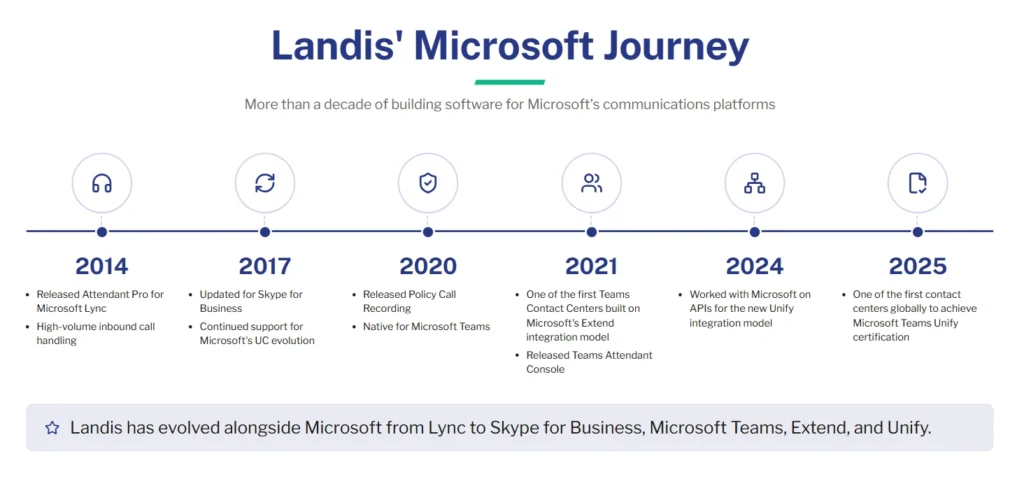
Microsoft’s Long-Standing Collaboration with Landis
Landis has worked alongside Microsoft on Teams contact center development since the early evolution of Microsoft Teams as a communications platform. Over the years, Microsoft has introduced new certification models to provide increasingly deeper integration between Teams and contact center platforms, with Landis consistently aligning its platform to these advancements.
Today, Landis is certified under both the Extend and Unify integration models, reflecting its continued investment in Microsoft’s latest contact center technologies and its focus on delivering a deeply integrated Teams experience.
Why Microsoft’s Extend and Unify Certifications Matter
Microsoft certifies contact centers using different integration models. While some platforms are certified under the Connect model, Landis is certified for both the Extend and Unify integration models.
The three models are degrees of how deeply the contact center lives inside Microsoft Teams. Connect bridges an outside platform to Teams over Direct Routing; Extend and Unify build the contact center into Teams itself. The closer it gets to native Teams, the more it changes the day-to-day.
For IT and telephony teams, deeper integration means less to own and fewer vendors to chase:
- No SBCs, Direct Routing, or servers to stand up. Agents are provisioned as ordinary Teams users
- One accountable support path
- Call media and data stay inside your Microsoft tenant, under the security and compliance rules you already enforce
- A single admin surface centered in Teams, instead of a separate portal bolted onto Direct Routing
For contact center operations, deeper integration means fewer missed calls and metrics that survive the move:
- Agents answer in the Teams window they already keep open all day without a separate app to forget to log into
- Routing reads Teams presence, so an agent already in a meeting is skipped automatically and wallboards reflect live metrics
- Agents can loop in a subject-matter expert or transfer to any colleague in Teams without dropping call history and notes
- Live monitoring, dashboards, and reporting sit in one place, so service levels hold through cutover instead of eroding after it
While every organization has different requirements, Microsoft’s certification models represent different approaches to Teams integration. Landis’ Extend and Unify certifications demonstrate that it supports Microsoft’s more advanced integration models rather than relying solely on the Connect approach.
What is Five9?
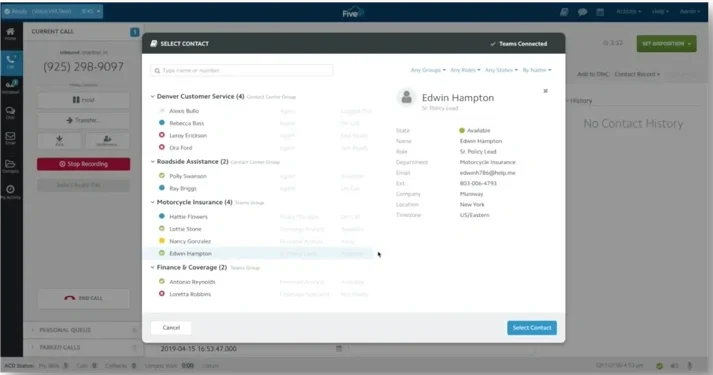
Five9 is a cloud contact center platform that integrates with Microsoft Teams through Microsoft’s Connect integration model. Rather than extending the Microsoft Teams client itself, Five9 connects its own cloud contact center platform with Teams, allowing agents to collaborate with colleagues while continuing to work in the Five9 Agent Desktop.
Five9 is certified under Microsoft’s Connect model. Its integration enables organizations to combine Teams collaboration with Five9’s contact center capabilities, including presence synchronization, directory search, click-to-call, call transfers, conferencing, and communication between contact center agents and Teams users.
The platform supports multiple customer engagement channels, including:
- Voice
- Chat
- SMS/MMS
- Social messaging
Five9 also offers a broad portfolio of AI capabilities designed to improve customer interactions and agent productivity, including:
- AI Agents
- Agent Assist
- AI-generated summaries
- Intelligent Virtual Agents (IVA)
- AI Insights
- AI Knowledge
- Live transcription
To integrate with existing business systems, Five9 provides documented integrations with platforms like:
- Microsoft Dynamics 365
- Salesforce
- ServiceNow
- Oracle
- Zendesk
- APIs
Beyond customer engagement, Five9 includes reporting and analytics, workforce engagement management, quality management, and workflow automation for enterprise contact centers.
Unlike Landis, Five9 is not currently certified under Microsoft’s Extend or Unify integration models. Instead, it uses the Connect integration model to link its contact center platform with Microsoft Teams while maintaining the Five9 Agent Desktop as the primary workspace for agents.
Landis Contact Center vs Five9: Feature Comparison
Landis Contact Center and Five9 both deliver enterprise-grade contact center capabilities for organizations using Microsoft Teams, but they take different approaches to integration.
Landis is certified under Microsoft’s Extend and Unify integration models, while Five9 integrates with Teams using the Connect model.
Beyond architecture, there are also differences in customer channels, AI capabilities, reporting, integrations, workforce management, deployment, and pricing.
Microsoft Teams Integration
The biggest distinction between the platforms is how they integrate with Teams.
Landis is certified under Microsoft’s Extend and Unify integration models, allowing agents and supervisors to work directly within your Teams interface. This approach is designed to reduce context switching and enables organizations to take advantage of Microsoft’s latest contact center integration capabilities.
Five9 is certified under the Connect integration model. Rather than working directly within Teams, agents use the Five9 Agent Desktop while integrating with Teams for collaboration features like presence synchronization, directory search, click-to-call, call transfers, conferencing, and communication with Teams users.
For organizations that have standardized on Microsoft Teams as their primary workspace, the difference in integration model may be an important consideration alongside features and pricing.
Customer Channels
Both platforms support omnichannel customer engagement, but the publicly documented channel portfolios differ.
Landis supports:
- Voice
- Web chat
- SMS
- Facebook Messenger
- Email (coming soon)
Five9 supports:
- Voice
- Chat
- SMS/MMS
- Social messaging
AI Capabilities
Historically, Five9 has been thought of as pioneering much automation in contact center technology. Its focus here excuses the lack of the focus on integration with Teams. Five9 targets the larger market of contact center users (specifically 50+ agents) whereas Landis has targeted companies embedded in Teams and the wider Microsoft ecosystem.
Landis provides:
- Conversational AI agents
- Agent Assist
- AI-generated summaries
- Intelligent routing
- Sentiment analysis
- Live coaching
- AI analytics
Five9 provides:
- AI Agents
- Agent Assist
- AI-generated summaries
- Intelligent Virtual Agents (IVA)
- AI Insights
- AI Knowledge
- Live transcription
Both platforms offer modern AI capabilities, although each has developed its own portfolio of AI tools and terminology.
Reporting and Analytics
Both platforms provide comprehensive reporting for supervisors, managers, and administrators.
Landis includes:
- Real-time dashboards
- Historical reporting
- Transcript reporting
- IVR reporting
- Scheduled reports
- Webhooks
- Role-based access control
- Microsoft Excel exports
Five9 includes:
- Real-time dashboards
- Historical reporting
- More than 140 pre-built reports
- Custom reports
- Scheduled reports
- Wallboards
- KPI and SLA reporting
- Advanced analytics
For most organizations, either platform provides the reporting needed to monitor contact center performance. Landis differentiates itself with capabilities like transcript reporting, IVR reporting, webhooks, and Excel exports, while Five9 emphasizes an extensive reporting library and advanced analytics.
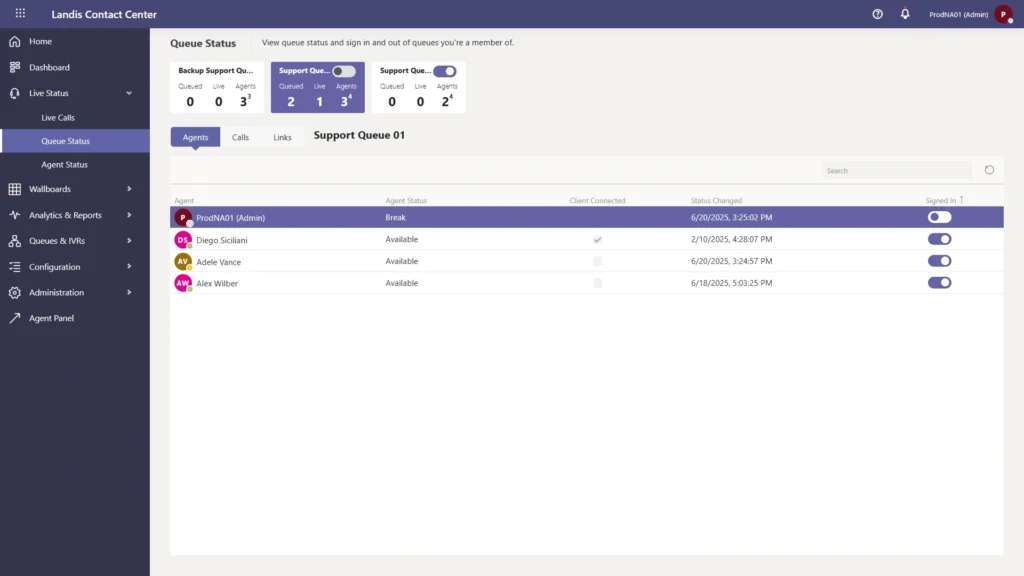
While Five9 may have more reports available, these must all be accessed outside of Teams. Again, Landis focuses on providing the total contact center inside your Teams client.
Deployment and Administration
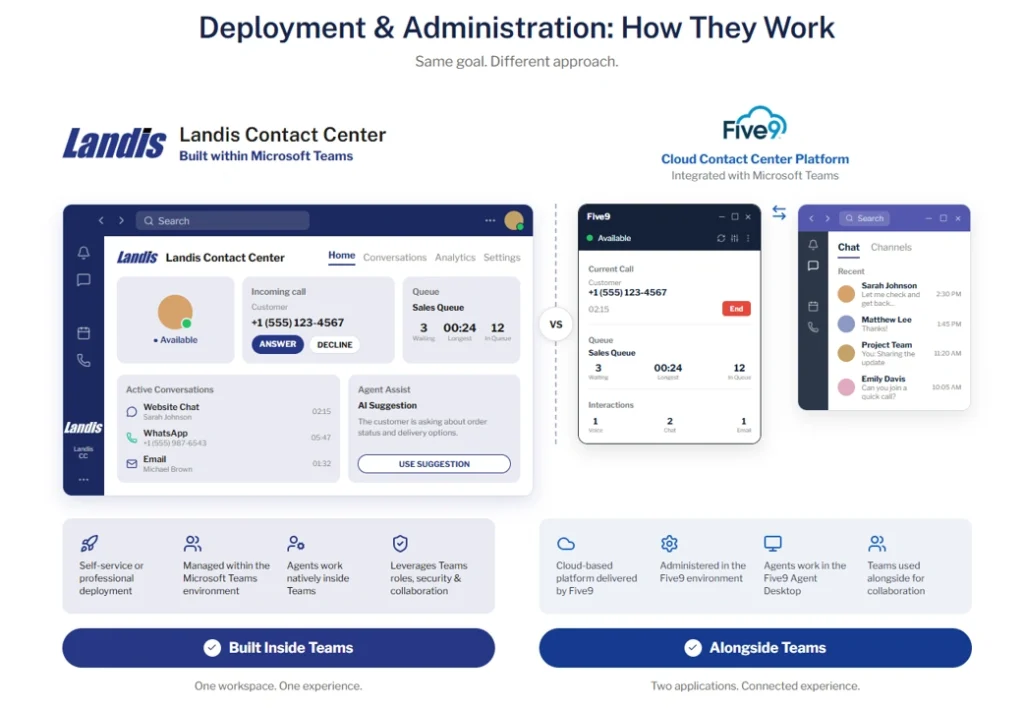
Landis offers both self-service deployment and professional implementation services, giving organizations flexibility in how they deploy and manage the platform.
Five9 is delivered as a cloud-based contact center platform, with administration performed through the Five9 management environment alongside its Microsoft Teams integration.
Both platforms are designed for enterprise deployments, but they differ in how agents interact with the platform and how Microsoft Teams fits into the overall user experience.
Landis Contact Center vs Five9 Pricing
Pricing is one of the clearest differences between Landis Contact Center and Five9, particularly for organizations comparing the published entry cost of each platform.
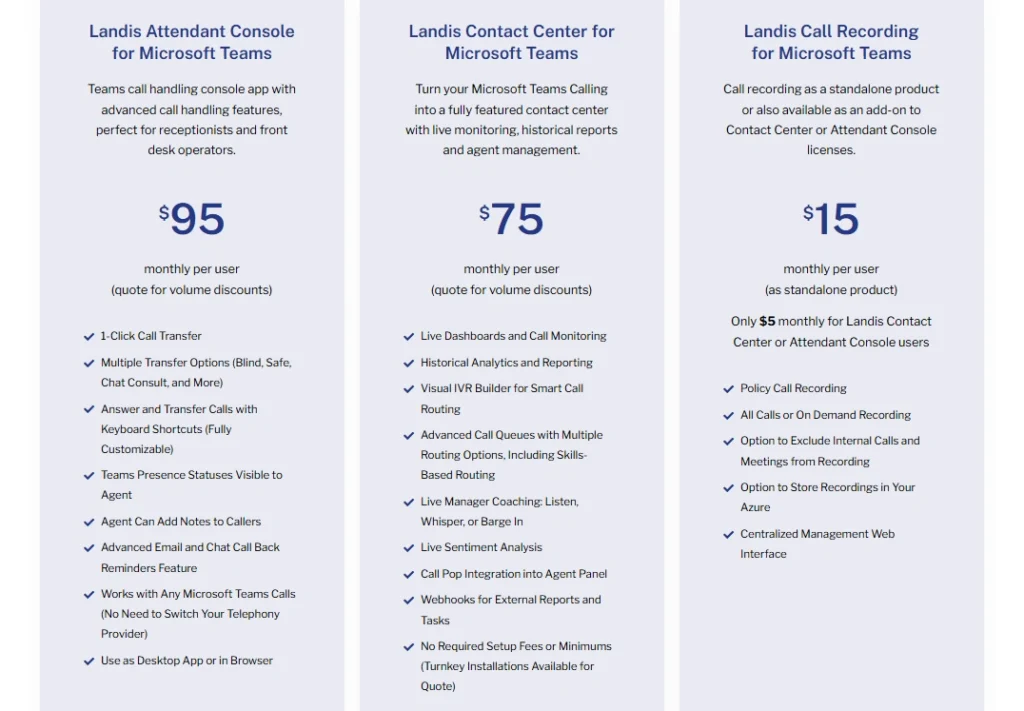
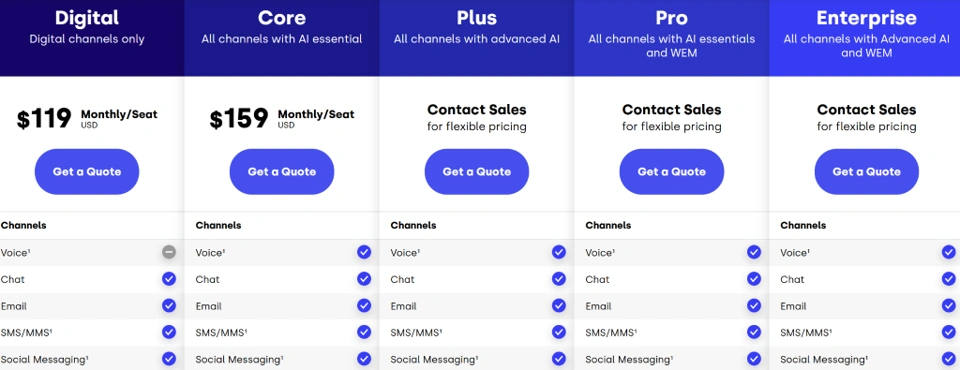
Landis pricing starts from $75 per user per month, with transparent pricing published on its website. You can also see clear pricing for standalone attendant console and call recording licenses where needed.
Five9 also publishes pricing, although it’s designed for organizations deploying a standalone enterprise contact center platform across their entire agent workforce rather than specifically for Microsoft Teams users. Five9 also states a minimum deployment of 50 agents, reflecting its focus on larger contact center environments.
| Plan | Landis Contact Center | Five9 |
|---|---|---|
| Entry-level | From $75/user/month | Digital: $119/user/month (digital channels only) |
| Voice-enabled | From $75/user/month | Core: $159/user/month |
| Higher tiers | Custom pricing | Plus, Pro and Enterprise: Custom pricing |
While Five9’s published pricing begins at $119 per user per month, that entry-level plan supports digital channels only and doesn’t include voice capabilities. Organizations looking for a voice-enabled deployment would typically compare against the Core plan, which starts at $159 per user per month.
Unlike Landis, which is built exclusively for Microsoft Teams, Five9 is a broader cloud contact center platform designed for enterprise contact centers regardless of their collaboration platform. Its published pricing reflects licensing for contact center agents rather than a Microsoft Teams-specific deployment model.
As with most enterprise contact center platforms, your total investment will depend on factors like the number of users, implementation services, integrations, AI capabilities, and any additional workforce management requirements. Both vendors also offer custom pricing for larger or more complex deployments.
Landis Contact Center vs Five9 Customer Reviews
Customer reviews can provide valuable insight into how each platform performs in real-world deployments, although experiences naturally vary depending on an organization’s requirements, implementation, and use cases.
Landis Contact Center
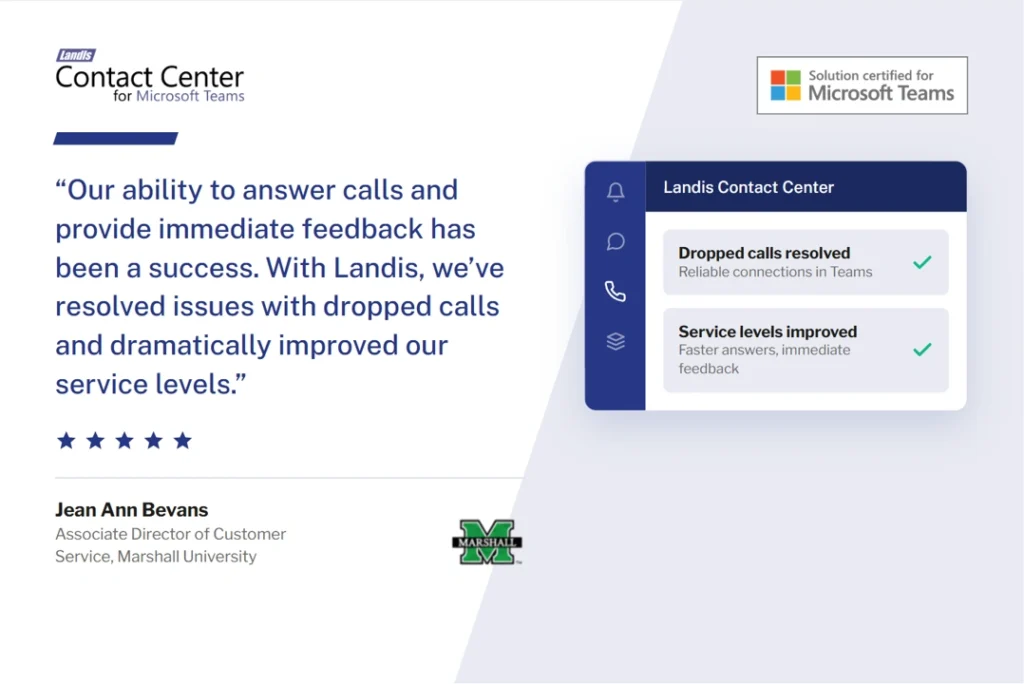
Landis customer success stories frequently highlight:
- Native Microsoft Teams experience
- Straightforward deployment
- Ease of use for agents
- Responsive customer support
- Flexibility for Microsoft-centric organizations
Organizations that have standardized on Microsoft Teams often value being able to keep agents inside Teams without introducing another desktop application.
Five9
Five9 customer feedback frequently highlights:
- Enterprise scalability
- Reporting and analytics
- AI capabilities
- Broad CRM integrations
- Microsoft Teams integration
One Five9 customer with Teams integration, Serefin, summarized their experience by saying:
“With Five9, I’ve never had to tell them we can’t do something. It just works.”
The same deployment also reported an 80% call deflection rate, improved reporting capabilities, and the ability to scale to 100 agents.
Customer Feedback Summary
Serefin is the only easily found case study of a Teams contact center deployment by Five9. That’s not to say there aren’t others. However, Landis has a bank full of Teams-first customer case studies that emphasize the Microsoft Teams-native experience and the simplicity of working within a single application.
Five9 customers more commonly highlight enterprise-scale functionality, reporting, AI capabilities, and the breadth of the overall contact center platform than the Teams integration.
Ultimately, the right choice depends less on review scores and more on whether your organization prioritizes a Microsoft Teams-native experience or a broader cloud contact center platform designed to support multiple collaboration environments.
Landis Contact Center vs Five9 Pros and Cons
No contact center platform is the right fit for every organization. The decision often comes down to how closely the platform aligns with your Microsoft strategy, operational requirements, and long-term roadmap.
| Landis Contact Center | Five9 |
|---|---|
| Pros | Pros |
| Native Microsoft Teams experience | Mature enterprise contact center platform |
| Microsoft Extend and Unify certified | Extensive AI portfolio |
| Agents work directly inside Teams | Comprehensive reporting and analytics |
| Transparent pricing from $75/user/month | |
| Self-service or professional implementation | Native workforce engagement management |
| Cons | Cons |
| Built specifically for Microsoft Teams environments | Agents work in the Five9 Agent Desktop rather than Microsoft Teams |
| Best suited to organizations invested in the Microsoft ecosystem only | Microsoft integration uses the Connect model rather than Extend or Unify |
| Workforce management requires a documented integration with Peopleware | Higher published entry pricing for voice-enabled deployments |
| Minimum deployment of 50 agents |
Neither platform is objectively better than the other but one is definitely more suited for a tailored audience:
- Landis is purpose-built for organizations that have standardized on Microsoft Teams and want agents to remain inside the Teams interface.
- Five9 is designed as a broader enterprise contact center platform that integrates with Microsoft Teams while supporting organizations with a wider range of collaboration environments and enterprise contact center requirements.
This distinction is often more important than individual feature comparisons, particularly for organizations making a long-term technology investment.
Should You Choose Landis or Five9 Contact Center?
Both Landis Contact Center and Five9 deliver enterprise-grade contact center capabilities, but they’re designed for different types of organizations.
Choose Landis Contact Center if you:
- Have standardized on Microsoft Teams across your organization.
- Want agents and supervisors to work directly inside Teams.
- Value Microsoft’s Extend and Unify integration models.
- Want a contact center built exclusively for the Microsoft ecosystem.
- Have fewer than 50 agents (even if you plan to scale in the future).
Note: Landis’ contact center scales infinitely. Whether you have 5 or 5,000 agents, the cloud architecture flexes to support you. However, Five9 has a lower limit of 50 agents for implementation, therefore suggesting it will not support new customers with fewer than 50 agents.
Choose Five9 if you:
- Need a cloud contact center platform that supports organizations regardless of their collaboration platform.
- Require native workforce engagement management.
- Are comfortable with agents working in a dedicated contact center desktop alongside Microsoft Teams.
Ultimately, the biggest differentiator isn’t the feature list. It’s the role Microsoft Teams plays in your contact center.
If Microsoft Teams is where your employees already spend their day, Landis enables agents to remain in that familiar workspace while extending Teams with enterprise contact center capabilities.
If you’re looking for a broader cloud contact center platform that integrates with Microsoft Teams but remains independent of it, Five9 may be the better fit for your organization.
Final Verdict
Landis is built exclusively for Microsoft Teams, allowing agents and supervisors to work directly within the Teams interface. Its Extend and Unify certifications demonstrate alignment with Microsoft’s latest contact center integration models, making it a compelling choice for organizations that have standardized on Teams.
Five9, meanwhile, is a mature cloud contact center platform that integrates with Microsoft Teams through Microsoft’s Connect model. Rather than becoming part of the Teams experience, Five9 operates alongside Teams, with agents continuing to work in the Five9 Agent Desktop while using Teams for collaboration features like presence, directory search, transfers, and conferencing.
The biggest difference between these platforms isn’t simply the feature list. It’s where your agents spend their day.
- With Landis, the contact center experience lives inside Microsoft Teams, allowing agents to handle customer interactions without leaving the application they already use for collaboration.
- With Five9, the contact center experience lives alongside Microsoft Teams. Teams remains a collaboration tool, while agents perform their contact center work in the dedicated Five9 Agent Desktop.
If your goal is to extend Microsoft Teams into a fully featured contact center, Landis offers the more deeply integrated approach. If you’re looking for a standalone enterprise contact center platform that integrates with Microsoft Teams but continues to operate independently of it, Five9 may be the better fit.
See What a Truly Teams-Native Contact Center Looks Like
Not all Microsoft Teams contact centers are built the same.
While many platforms integrate alongside Teams, Landis is built inside Teams. As one of the few contact centers certified under Microsoft’s Extend and Unify integration models, Landis enables your agents to work in the application they already know while delivering enterprise-grade customer experiences.
If your organization has invested in Microsoft Teams, why force agents to switch to another desktop?
Book a personalized demo to see how Landis extends Microsoft Teams with omnichannel customer engagement, AI-powered automation, real-time reporting, and enterprise integrations, all without leaving the Teams interface.