
By Dominic Kent
Dominic Kent is an independent writer who specializes in unified communications and contact center technology. He runs UC Marketing Ltd, a consultancy dedicated to helping technology companies translate complex technology products into compelling stories and educational content. His projects often involve well-researched guides that speaks to IT leaders and business stakeholders alike.
Table of contents
- Landis Contact Center vs Genesys Cloud CX at a Glance
- What Is Landis Contact Center?
- What Is Genesys Cloud CX?
- Landis Contact Center vs Genesys Cloud CX: Microsoft Teams Integration
- Landis Contact Center vs Genesys Cloud CX: Complexity and Modernization
- Landis Contact Center vs Genesys Cloud CX: AI Capabilities
- Landis Contact Center vs Genesys Cloud CX: Omnichannel Capabilities
- Landis Contact Center vs Genesys Cloud CX: Pricing
- Landis Contact Center vs Genesys Cloud CX: Which Is Right for You?
- See What a Microsoft Teams-First Contact Center Looks Like
Landis Contact Center and Genesys Cloud CX are built for different challenges.
- If your organization has standardized on Microsoft Teams, Landis is designed to transform Teams into a complete contact center.
- If your organization is modernizing a complex communications environment, Genesys Cloud CX is designed to orchestrate customer experiences across multiple systems, channels, and integrations.
Both platforms deliver enterprise-grade contact center capabilities, AI, and omnichannel communications. The difference lies in how they’re designed, the problems they solve, and the organizations they serve.
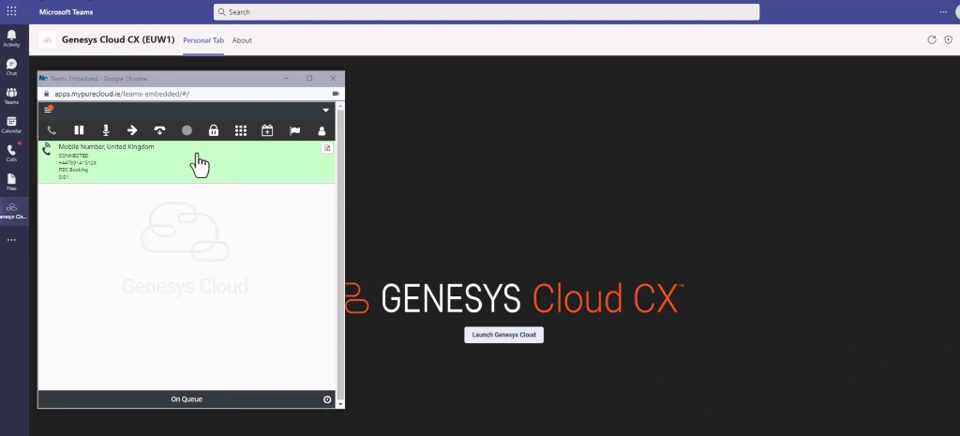
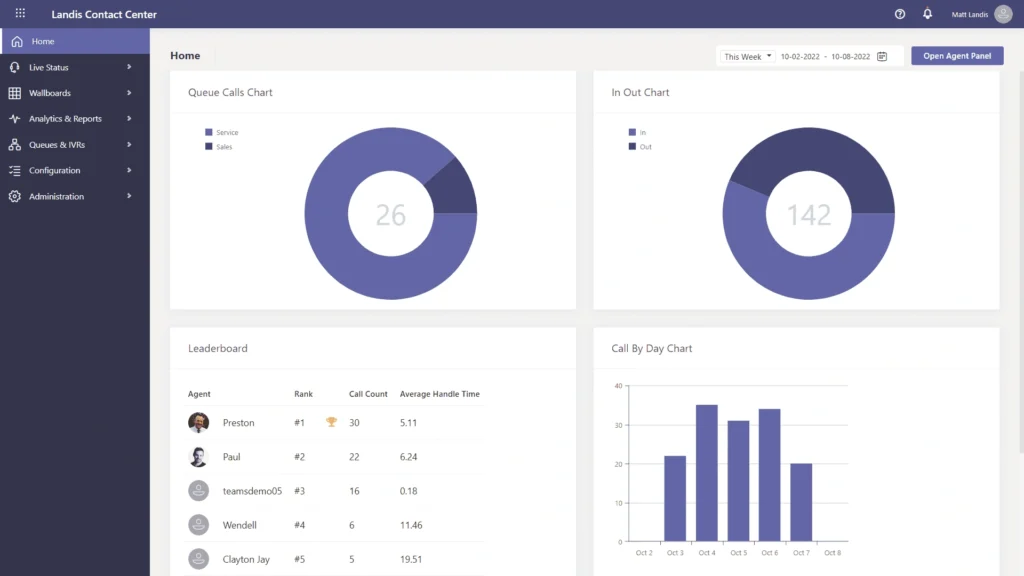
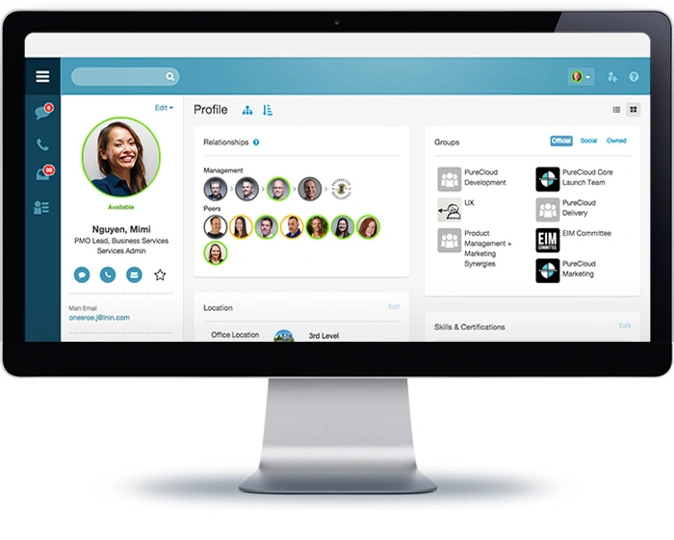
From the outset, there are visual differences in the agent experience. These may make your mind up before you even dig into the features and strength of Teams integration.
Genesys embeds its own contact center into your Teams interface:
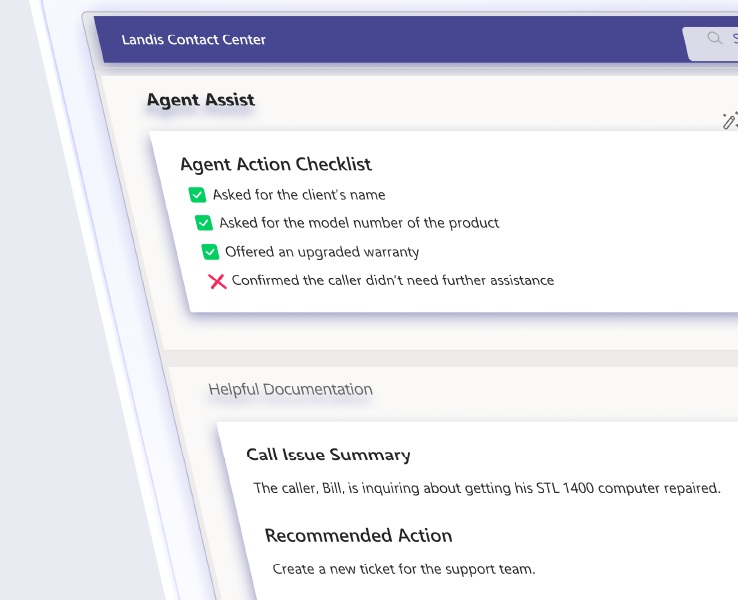
Landis uses the same designed language as Microsoft Teams to provide a Teams-first experience for your agents already used to using Teams:
This comparison explores the differences between Landis Contact Center and Genesys Cloud CX, comparing Microsoft Teams integration, AI, and pricing to help you determine which platform is the better fit for your business.
Landis Contact Center vs Genesys Cloud CX at a Glance
| Capability | Landis | Genesys Cloud CX |
|---|---|---|
| Primary focus | Microsoft Teams contact center | Experience orchestration platform |
| Microsoft Connect certification | ✅ | ✅ |
| Microsoft Extend certification | ✅ | Presence integration |
| Microsoft Unify certification | ✅ | ❌ |
| Primary agent workspace | Microsoft Teams | Genesys Cloud CX |
| Interface approach | Extends the Microsoft Teams experience | Genesys Cloud application embedded in Teams |
| Public pricing | ✅ | ✅ |
Landis Contact Center and Genesys Cloud CX both integrate with Microsoft Teams, but they take different approaches.
Landis extends Teams into a complete contact center, maintaining a familiar Microsoft experience across agents, supervisors, reporting, and administration.
Genesys Cloud CX embeds its own application within Microsoft Teams. Users benefit from Teams integration for collaboration and communications while continuing to work primarily within the Genesys Cloud interface.
The difference reflects the role each platform is designed to play:
- Landis is built for organizations that want Microsoft Teams to become their contact center.
- Genesys Cloud CX is designed for organizations that need a broader experience orchestration platform with Microsoft Teams integration.
What Is Landis Contact Center?
Landis Contact Center is a Microsoft Teams-first contact center built exclusively for organizations using Microsoft Teams. Rather than introducing another communications platform, Landis extends Teams with enterprise contact center capabilities while maintaining the familiar Microsoft experience.
The platform combines voice, digital channels, AI, and reporting within Microsoft Teams, allowing agents and supervisors to manage customer interactions without leaving the Teams environment.
Its capabilities include:
- Native Microsoft Teams contact center.
- AI-powered Agent Assist and automation.
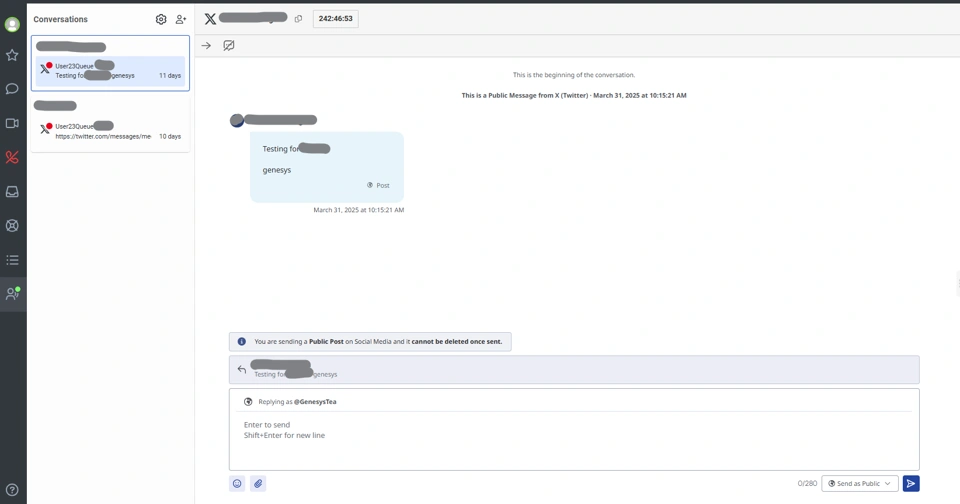
- Omnichannel support for voice, web chat, SMS, WhatsApp, Facebook Messenger, and RCS.
- Live dashboards, reporting, and speech analytics.
- Workforce management and CRM integrations.
- Microsoft Connect, Extend, and Unify certification.
Landis is designed for organizations that have standardized on Microsoft 365 and want Microsoft Teams to become the center of their customer communications.
By focusing exclusively on Teams, every product enhancement, integration, and customer workflow is built around a single platform rather than balancing multiple communications ecosystems.
A Long History of Building for Microsoft
One of Landis’ biggest differentiators is its long-standing investment in Microsoft’s communications platforms.
From the beginning, it’s built software that integrates deeply with Microsoft technologies, evolving alongside Microsoft’s unified communications strategy from Lync to Skype for Business and now Microsoft Teams.
Rather than entering the Teams contact center market after Teams became mainstream, Landis had already established years of experience developing Microsoft-integrated communications software.
Microsoft Timeline
- 2014: Released Attendant Pro for Microsoft Lync, helping organizations manage high volumes of inbound calls.
- 2017: Updated Attendant Pro for Skype for Business, ensuring customers could continue supporting Microsoft’s evolving communications platform.
- 2020: Released Policy Call Recording for Microsoft Teams, expanding its growing Microsoft Teams portfolio.
- 2021: Released one of the first Microsoft Teams contact center solutions built on Microsoft’s Extend integration model, followed shortly by its Microsoft Teams Attendant Console.
- 2024: Worked closely with Microsoft to help develop APIs for the new Unify integration model.
- 2025: Became one of the first contact center vendors globally to achieve Microsoft Teams Unify certification.
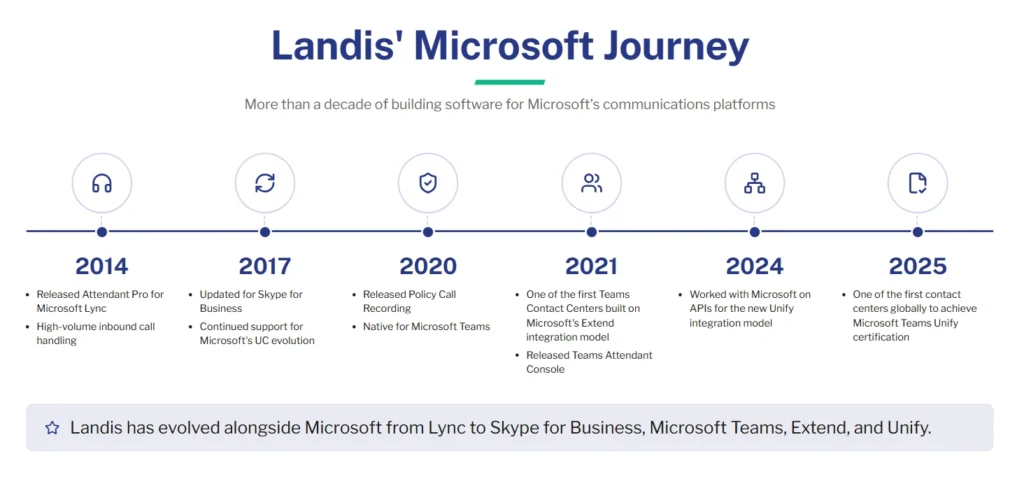
This progression demonstrates consistent investment in Microsoft’s communications ecosystem for more than a decade. As Microsoft introduced new platforms and integration models, Landis continued evolving its products to align with Microsoft’s latest architecture.
For organizations that have standardized on Microsoft Teams, that history demonstrates a sustained commitment to Microsoft’s ecosystem rather than a recent expansion into the contact center market.
What Is Genesys Cloud CX?
Genesys Cloud CX is an AI-powered experience orchestration platform that helps organizations manage customer interactions across voice, digital channels, and self-service.
While it integrates with Microsoft Teams, the platform is designed to orchestrate customer experiences across multiple communications systems rather than focusing exclusively on the Microsoft ecosystem.
With decades of experience in the contact center market, Genesys is widely used by organizations operating complex customer service environments. The platform is particularly well suited to businesses managing multiple locations, global operations, or communications estates that include legacy telephony infrastructure alongside modern cloud services.
Its capabilities include:
- AI-powered experience orchestration, virtual agents, and Agent Copilot.
- Omnichannel support for voice, email, messaging, and social channels.
- Workforce engagement, quality management, and workforce management.
- Journey management, predictive routing, and speech analytics.
- Extensive CRM, telephony, and business application integrations.
- Microsoft Teams integration and Microsoft Connect certification.
Genesys Cloud CX is designed for organizations modernizing complex communications environments without sacrificing the capabilities they’ve built over many years.
Whether migrating from legacy PBXs, integrating multiple business systems, or supporting highly regulated operations, the platform provides the flexibility to unify customer engagement across diverse technology environments.
Landis Contact Center vs Genesys Cloud CX: Microsoft Teams Integration
Microsoft Teams integration is one of the biggest considerations when choosing a contact center. While both Landis and Genesys Cloud CX integrate with Teams, they take very different approaches to the agent experience.
| Capability | Landis | Genesys Cloud CX |
|---|---|---|
| Microsoft Connect certification | ✅ | ✅ |
| Microsoft Extend certification | ✅ | Presence integration |
| Microsoft Unify certification | ✅ | ❌ |
| Primary agent workspace | Microsoft Teams | Genesys Cloud CX |
| Interface approach | Extends the Microsoft Teams experience | Genesys Cloud application embedded in Teams |
Landis
Landis is built for Microsoft Teams. Agents, supervisors, and administrators work within a familiar Microsoft interface while accessing enterprise contact center capabilities such as omnichannel routing, AI, reporting, and workforce management.
Rather than asking users to learn another application, Landis extends Microsoft Teams into a complete contact center, making Teams the primary workspace for customer communications.
Genesys Cloud CX
Genesys Cloud CX integrates with Teams, allowing users to collaborate with colleagues, synchronize presence, launch calls, and access Genesys functionality from within Teams.
The contact center app itself, however, remains the Genesys Cloud application. Customer interactions are handled through the Genesys interface, with Microsoft Teams acting as the collaboration layer between agents and the wider business.
Landis Contact Center vs Genesys Cloud CX: Complexity and Modernization
Landis and Genesys Cloud CX are designed for different implementation journeys. While both support enterprise organizations, the complexity of the communications environment often determines which platform is the better fit.
| Capability | Landis | Genesys Cloud CX |
|---|---|---|
| Microsoft Teams-first deployments | ✅ | ⚠️ |
| Legacy PBX modernization | ⚠️ | ✅ |
| Hybrid telephony environments | ⚠️ | ✅ |
| Complex business integrations | ✅ | ✅ |
| Global multi-site deployments | ✅ | ✅ |
| Highly regulated industries | ✅ | ✅ |
Landis
Landis is built for organizations that have already standardized on Microsoft Teams. Rather than preserving years of legacy telephony architecture, the platform helps businesses extend Teams into a complete contact center with a familiar user experience and straightforward deployment.
For organizations adopting Microsoft Teams as their long-term communications platform, Landis provides a direct path to modern cloud customer service without introducing unnecessary complexity.
Genesys Cloud CX
Genesys Cloud CX is often chosen by organizations modernizing complex communications environments. Businesses operating across multiple locations, supporting global operations, or migrating from legacy PBXs frequently use Genesys to replicate and evolve existing customer service capabilities in the cloud.
The platform is also well suited to highly regulated industries where compliance, resilience, and extensive system integration are central to the contact center strategy. These projects typically involve a more consultative implementation, reflecting the complexity of the environments Genesys is designed to support.
Key Difference
The choice isn’t about company size. It’s about communications complexity.
- Landis is optimized for organizations that want Microsoft Teams to become their contact center, providing a focused platform built around the Microsoft ecosystem.
- Genesys Cloud CX is designed for organizations modernizing complex communications estates, where multiple communications systems, integrations, and operational requirements need to be unified within a single customer experience platform.
Landis Contact Center vs Genesys Cloud CX: AI Capabilities
Artificial intelligence plays an important role in both Landis and Genesys Cloud CX, but the platforms apply it in different ways.
Both use AI to improve customer experiences and support agents, while Genesys extends AI into journey orchestration and broader customer experience management.
| AI Capability | Landis | Genesys Cloud CX |
|---|---|---|
| Agent Assist | ✅ | ✅ |
| Virtual agents | ✅ | ✅ |
| AI-powered summaries | ✅ | ✅ |
| Speech analytics | ✅ | ✅ |
| Intelligent routing | ✅ | ✅ |
| Journey orchestration | ❌* | ✅ |
*Landis coordinates routing, IVR, and reporting across channels, but does not have Genesys’ degree of predictive customer journey orchestration.
Landis
Landis brings AI directly into Microsoft Teams, helping agents and supervisors work more efficiently without leaving their primary workspace.
Features like Agent Assist, virtual agents, AI-generated summaries, intelligent routing, and speech analytics improve productivity while maintaining a familiar Microsoft Teams experience.
The focus is on using AI to enhance the contact center, reducing manual effort and helping organizations deliver faster, more consistent customer service.
Genesys Cloud CX
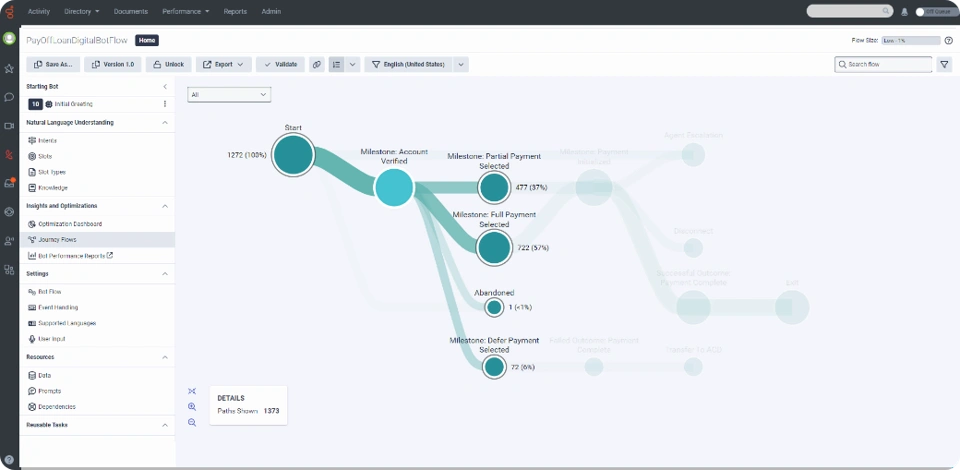
Genesys Cloud CX places AI at the center of its experience orchestration platform. Alongside Agent Copilot, virtual agents, and intelligent routing, the platform uses AI to orchestrate customer journeys, automate interactions, and optimize operational performance across multiple channels.
This broader approach enables organizations to coordinate customer experiences beyond the contact center, connecting AI with routing, workforce optimization, and journey management.
Key Difference
Both platforms provide comprehensive AI capabilities, including Agent Assist, virtual agents, intelligent routing, and speech analytics.
The difference lies in how AI is applied.
Landis uses AI to strengthen the Microsoft Teams contact center experience, helping agents and supervisors work more efficiently within Teams.
Genesys Cloud CX extends AI beyond the contact center, using it to orchestrate customer journeys and automate interactions across a wider customer engagement platform.
Landis Contact Center vs Genesys Cloud CX: Omnichannel Capabilities
Both Landis and Genesys Cloud CX provide comprehensive omnichannel capabilities, although Genesys supports a broader range of digital engagement channels.
| Channel | Landis | Genesys Cloud CX |
|---|---|---|
| Voice | ✅ | ✅ |
| Roadmap | ✅ | |
| Web chat | ✅ | ✅ |
| SMS | ✅ | ✅ |
| ✅ | ✅ | |
| Facebook Messenger | ✅ | ✅ |
| ❌ | ✅ | |
| Apple Messages for Business | ❌ | ✅ |
| X (formerly Twitter) | ❌ | ✅ |
| Video | ❌ | ✅ |
| RCS | ✅ | ❌ |
Landis
Landis focuses on the communication channels most commonly used by Microsoft Teams organizations. Alongside voice, the platform supports web chat, SMS, WhatsApp, Facebook Messenger, and RCS, giving organizations the flexibility to engage customers across the channels they use every day.
By concentrating on the channels most relevant to Microsoft-centric businesses, Landis provides a streamlined omnichannel experience without introducing unnecessary complexity.
Genesys Cloud CX
Genesys Cloud CX supports one of the broadest omnichannel portfolios in the industry. In addition to voice, web chat, SMS, and WhatsApp, the platform includes email, Instagram, Apple Messages for Business, X (Twitter), and video.
This breadth makes Genesys well suited to organizations managing high volumes of customer interactions across multiple brands, regions, or communication channels.
Landis Contact Center vs Genesys Cloud CX: Customer Reviews
What customers like about Landis
Customers typically highlight:
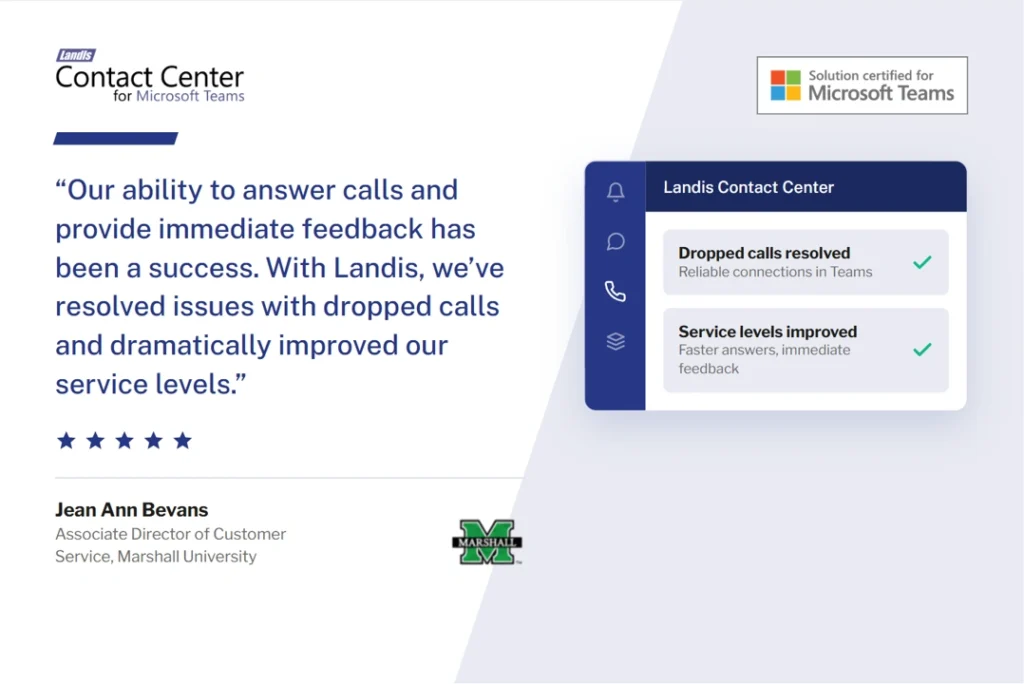
- Microsoft Teams-first experience.
- Straightforward deployment.
- Responsive support and close collaboration with the Landis team.
For organizations already using Microsoft Teams, reviewers frequently mention the benefit of managing customer communications without introducing another desktop application.
What customers like about Genesys Cloud CX
Genesys Cloud CX is consistently praised for:
- Extensive functionality.
- Broad integration capabilities.
- Scalability for complex environments.
Customers often highlight the platform’s flexibility and ability to support sophisticated routing, automation, and customer engagement strategies across large organizations.
Common criticisms
The biggest difference in customer feedback is complexity.
Landis is generally viewed as easier to adopt because the experience is centered around Microsoft Teams and focuses on a single communications ecosystem.
Genesys Cloud CX, on the other hand, is frequently described as requiring more planning, configuration, and administration. Customers often note that the platform’s extensive capabilities come with a steeper learning curve, particularly during implementation and when configuring advanced workflows.
Landis Contact Center vs Genesys Cloud CX: Pricing
While both Landis and Genesys publish their licensing costs, they take different approaches to packaging features and scaling the platform.
| Pricing | Landis | Genesys Cloud CX |
|---|---|---|
| Public pricing | ✅ | ✅ |
| Entry-level contact center | From $75/user/month | CX 1: $75/user/month |
| Mid-tier options | Simple licensing | CX 2: $115/user/month |
| Advanced capabilities | Add only what you need | CX 3: $155/user/month |
| Enterprise capabilities | Volume discounts available | CX 4: $240/user/month |
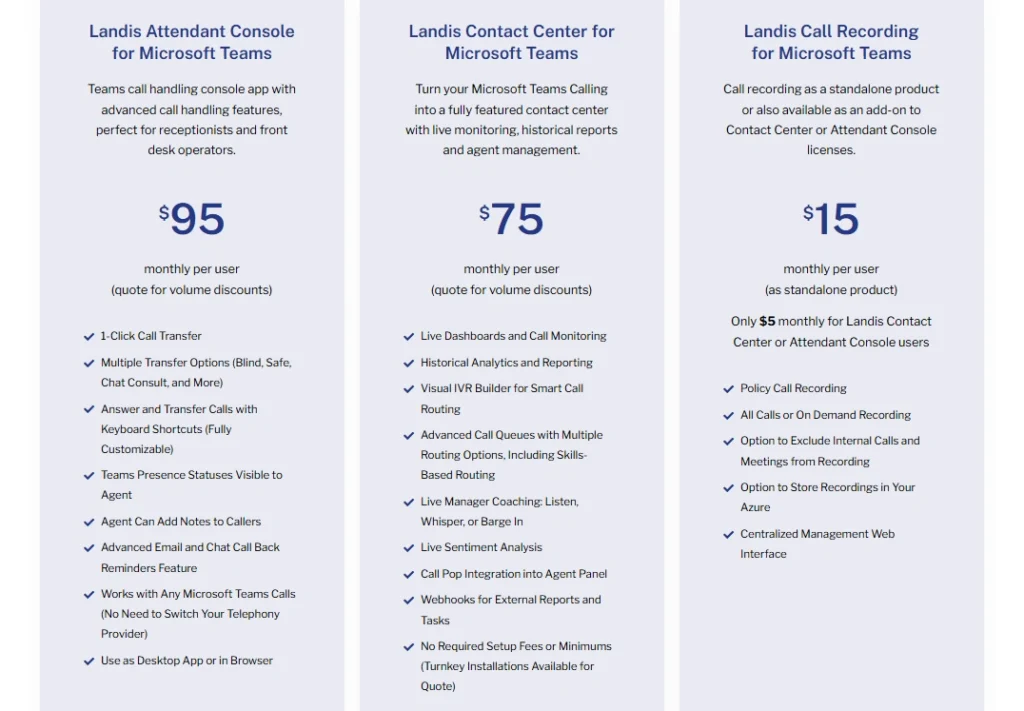
You can also see clear pricing for standalone attendant console and call recording licenses where needed with Landis.
Landis
Landis publishes straightforward pricing that allows organizations to estimate costs before engaging with sales. Rather than selecting from multiple editions, customers can build a Teams contact center around the capabilities they need while benefiting from transparent pricing and volume discounts as deployments grow.
This approach makes it easier for IT leaders and procurement teams to budget for Microsoft Teams contact center projects without navigating multiple licensing tiers.
Genesys Cloud CX
Genesys Cloud CX publishes pricing but the platform is structured around four editions that progressively unlock more advanced capabilities. As organizations require AI, workforce engagement, journey orchestration, or advanced digital channels, they typically move into higher licensing tiers.
Landis Contact Center vs Genesys Cloud CX: Which Is Right for You?
Landis Contact Center and Genesys Cloud CX are both enterprise-grade contact center platforms, but they’re designed to solve different business challenges. The right choice depends on your communications strategy, existing technology, and long-term objectives.
Choose Landis Contact Center if you:
- Have standardized on Microsoft Teams.
- Want Microsoft Teams to become your contact center.
- Prefer a familiar Teams experience for agents and supervisors.
- Value straightforward deployment and predictable licensing.
- Want deep Microsoft integration with Microsoft’s highest certification levels.
Choose Genesys Cloud CX if you:
- Are modernizing a complex communications environment.
- Need to integrate multiple telephony platforms or business systems.
- Want an experience orchestration platform with extensive AI capabilities.
- Need a contact center designed for highly customized customer engagement strategies.
Final Verdict
Landis Contact Center and Genesys Cloud CX both deliver enterprise-grade customer engagement, but they start from different foundations.
Landis starts with Microsoft Teams. It extends the familiar Teams experience into a complete contact center, making it an excellent choice for organizations that have already invested in Microsoft 365 and want Teams to become the center of their customer communications.
Genesys Cloud CX starts with the contact center itself. It brings together AI, omnichannel engagement, and enterprise integrations to help organizations modernize complex communications environments while integrating with Microsoft Teams as part of a broader customer experience strategy.
- If your goal is to transform Microsoft Teams into your contact center, Landis offers a focused, Teams-first platform designed specifically for that purpose.
- If your challenge is modernizing a large, complex communications estate with extensive integration requirements, Genesys Cloud CX provides flexibility and depth.
See What a Microsoft Teams-First Contact Center Looks Like
Choosing a contact center isn’t just about features. It’s about choosing the platform that fits the way your business works.
If your organization has already standardized on Microsoft Teams, why force agents to spend their day in another application?
Landis extends Microsoft Teams into a complete contact center, allowing agents, supervisors, and administrators to work within the Microsoft environment they already know.
With AI, omnichannel communications, workforce management, and Microsoft’s highest certification levels, it’s built specifically for organizations that want Microsoft Teams to become the center of their customer communications.
Book a personalized demo to see how Landis transforms Microsoft Teams into an enterprise contact center.