
By Dominic Kent
Dominic Kent is an independent writer who specializes in unified communications and contact center technology. He runs UC Marketing Ltd, a consultancy dedicated to helping technology companies translate complex technology products into compelling stories and educational content. His projects often involve well-researched guides that speaks to IT leaders and business stakeholders alike.
Table of contents
- Landis Contact Center vs Luware Nimbus at a Glance
- What is the Landis Contact Center?
- What Is Luware Nimbus?
- Landis Contact Center vs Luware Nimbus: Feature Comparison
- Landis Contact Center vs Luware Nimbus Pricing
- Customer Reviews
- Pros and Cons of Landis and Luware
- Should You Choose Landis Contact Center or Luware Nimbus?
- See Why Organizations Choose Landis Contact Center
Choosing a Microsoft Teams contact center isn’t just about comparing feature lists. It’s about finding the platform that best complements the way your business already communicates and collaborates.
Landis Contact Center and Luware Nimbus are both Microsoft-certified contact center solutions for Microsoft Teams. Rather than requiring agents to work in a separate desktop application, both extend Microsoft Teams with enterprise contact center capabilities, allowing agents to manage customer interactions within the familiar Teams interface.
While they share that common foundation, there are some important differences. Landis is certified under Microsoft’s Extend and Unify models, while Luware Nimbus is currently certified under the Extend model. The platforms also differ in their AI capabilities, reporting, omnichannel support, CRM integrations, workforce management, and pricing.
In this comparison, we’ll examine Landis Contact Center and Luware Nimbus across the areas that matter most, helping you decide which solution is the better fit for your business.
Landis Contact Center vs Luware Nimbus at a Glance
| Feature | Landis Contact Center | Luware Nimbus |
|---|---|---|
| Microsoft certification | Extend and Unify | Extend |
| Agent experience | Native Microsoft Teams interface | Native Microsoft Teams interface |
| Deployment | Microsoft Azure | Microsoft Azure |
| Voice | ✓ | ✓ |
| Digital channels | Voice, web chat, SMS, WhatsApp, RCS, Facebook Messenger | Voice, web chat, email, SMS, WhatsApp, Facebook Messenger |
| AI capabilities | AI agents, Agent Assist, AI summaries, intelligent routing, sentiment analysis, coaching | AI virtual users, AI summaries, transcription, intelligent routing, agent assistance |
| Reporting | Real-time and historical reporting, dashboards, transcript analytics, IVR reporting | Live dashboards, historical reporting, Power BI reporting, service analytics |
| CRM integrations | Dynamics 365, Salesforce, HubSpot, ServiceNow, Zendesk, Zoho, Freshworks, API | Dynamics 365, Salesforce, ServiceNow, HubSpot, Zendesk, Power Automate, API |
| Workforce management | Peopleware integration | Workforce management integrations available |
| Published pricing | From USD 75 per user/month | USD 85 per user/month (up to 199 users) |
What is the Landis Contact Center?
Landis Contact Center is a Microsoft-certified contact center solution built exclusively for Microsoft Teams. It enables you to deliver customer service across voice and digital channels without requiring agents to leave the Teams environment.
Rather than introducing a separate agent desktop, Landis extends Microsoft Teams with enterprise contact center capabilities. Your agents can answer calls, manage digital conversations, access customer information, and collaborate with colleagues from a single interface, reducing the need to switch between multiple applications.
Whether you operate a small customer service team or a large enterprise contact center, Landis provides the tools you need to manage customer interactions at scale, including:
- Intelligent call routing
- Interactive voice response (IVR)
- Skills-based routing
- AI-powered agent assistance
- Omnichannel customer engagement
- Real-time reporting and analytics
- CRM integrations
- Workforce management capabilities
One of the platform’s key differentiators is its Microsoft certification. Landis has achieved both Microsoft’s Extend and Unify certifications, demonstrating that it meets Microsoft’s technical requirements for deep integration with Microsoft Teams while supporting advanced unified communications scenarios.
If you’ve standardized on Microsoft Teams, Landis builds on the platform your employees already use instead of replacing it with a separate contact center application. This simplifies user adoption, reduces training requirements, and helps you manage customer communications and internal collaboration from a single Microsoft ecosystem.
Why Microsoft’s Extend and Unify Certifications Matter
Microsoft certifies contact centers using different integration models. While some platforms are certified under the Connect model, Landis is certified for both the Extend and Unify integration models.
The three models are degrees of how deeply the contact center lives inside Microsoft Teams. Connect bridges an outside platform to Teams over Direct Routing; Extend and Unify build the contact center into Teams itself. The closer it gets to native Teams, the more it changes the day-to-day.
For IT and telephony teams, deeper integration means less to own and fewer vendors to chase:
- No SBCs, Direct Routing, or servers to stand up. Agents are provisioned as ordinary Teams users
- One accountable support path
- Call media and data stay inside your Microsoft tenant, under the security and compliance rules you already enforce
- A single admin surface centered in Teams, instead of a separate portal bolted onto Direct Routing
For contact center operations, deeper integration means fewer missed calls and metrics that survive the move:
- Agents answer in the Teams window they already keep open all day without a separate app to forget to log into
- Routing reads Teams presence, so an agent already in a meeting is skipped automatically and wallboards reflect live metrics
- Agents can loop in a subject-matter expert or transfer to any colleague in Teams without dropping call history and notes
- Live monitoring, dashboards, and reporting sit in one place, so service levels hold through cutover instead of eroding after it
While certification shouldn’t be the only factor in your decision, it does provide an independent benchmark when comparing vendors. It also demonstrates a commitment to aligning with Microsoft’s product roadmap, which can give you greater confidence as Microsoft Teams continues to evolve.
Ultimately, both platforms meet Microsoft’s requirements for extending Teams into a modern contact center. If achieving both Extend and Unify certification is important to your deployment strategy, Landis currently has the advantage.
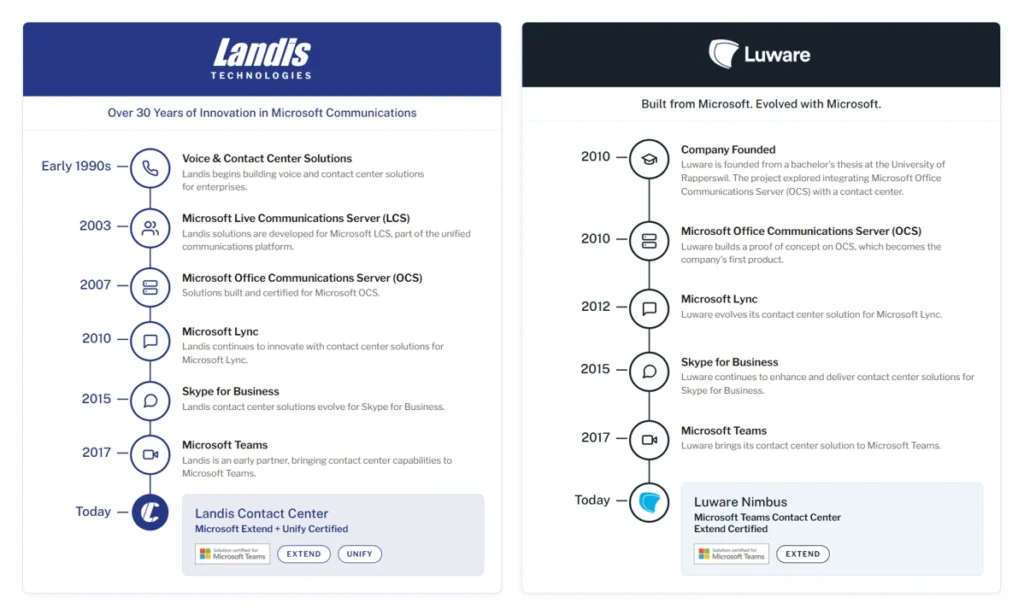
A Long History of Building for Microsoft
One of Landis’ biggest differentiators is its long-standing investment in Microsoft’s communications platforms.
From the beginning, Landis has built software that integrates deeply with Microsoft technologies, evolving alongside Microsoft’s unified communications strategy from Lync to Skype for Business and now Microsoft Teams.
Rather than entering the Teams contact center market after Teams became mainstream, Landis had already established years of experience developing Microsoft-integrated communications software.
Microsoft Timeline
- 2014: Released Attendant Pro for Microsoft Lync, helping organizations manage high volumes of inbound calls.
- 2017: Updated Attendant Pro for Skype for Business, ensuring customers could continue supporting Microsoft’s evolving communications platform.
- 2020: Released Policy Call Recording for Microsoft Teams, expanding its growing Microsoft Teams portfolio.
- 2021: Released one of the first Microsoft Teams contact center solutions built on Microsoft’s Extend integration model, followed shortly by its Microsoft Teams Attendant Console.
- 2024: Worked closely with Microsoft to help develop APIs for the new Unify integration model.
- 2025: Became one of the first contact center vendors globally to achieve Microsoft Teams Unify certification.
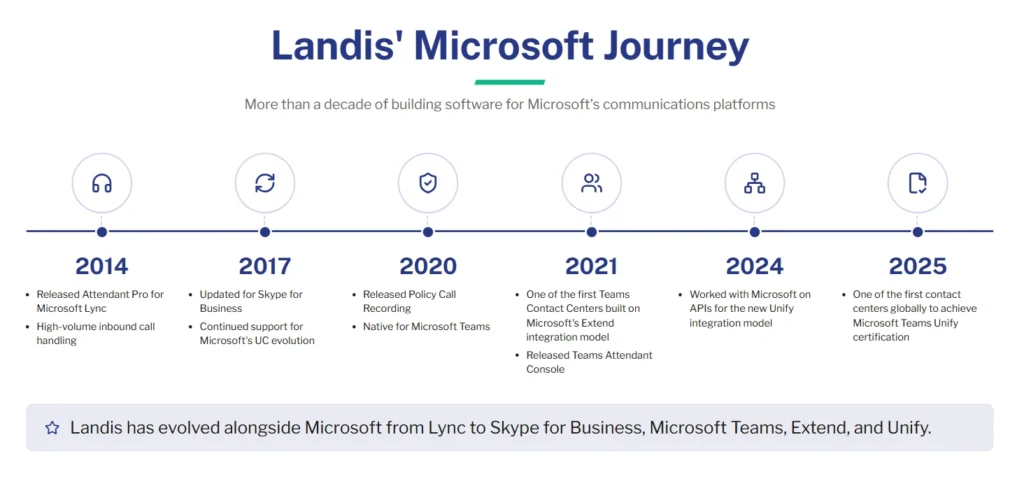
This progression demonstrates consistent investment in Microsoft’s communications ecosystem for more than a decade. As Microsoft introduced new platforms and integration models, Landis continued evolving its products to align with Microsoft’s latest architecture.
What Is Luware Nimbus?
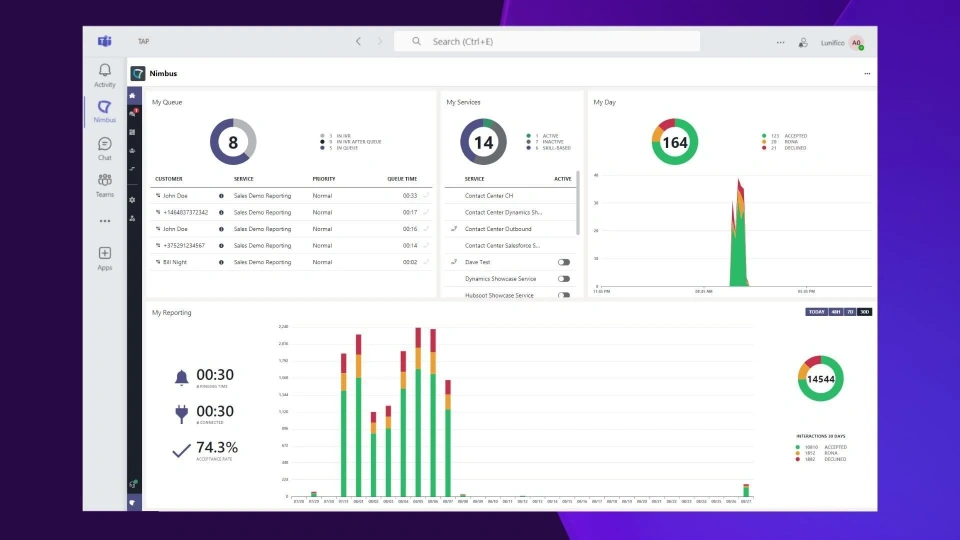
Luware Nimbus is a Microsoft-certified contact center solution built for Microsoft Teams. It enables you to manage customer interactions across voice and digital channels while allowing your agents to continue working within the Teams interface.
Like Landis, Luware has specialized in Microsoft communications technologies for many years, evolving from solutions built for Microsoft Lync and Skype for Business to a cloud-native contact center designed for Microsoft Teams.
Rather than replacing Teams with a separate application, Luware extends the platform with enterprise contact center functionality. Your agents can handle customer conversations, collaborate with colleagues, and access the information they need without switching between multiple desktops.
Whether you run a help desk, customer service team, or enterprise contact center, Luware Nimbus provides a comprehensive set of capabilities, including:
- Intelligent call routing
- IVR
- Skills-based routing
- Omnichannel customer engagement
- AI virtual users
- AI-powered agent assistance
- Real-time dashboards and historical reporting
- CRM integrations
- Workflow automation
Luware has achieved Microsoft’s Extend certification, demonstrating that the platform meets Microsoft’s requirements for extending Microsoft Teams with enterprise contact center capabilities.
If you’ve invested in Microsoft Teams, Luware Nimbus allows you to build your contact center around the collaboration platform your employees already use. This reduces the need for additional agent applications while helping you deliver a more connected customer experience.
Landis Contact Center vs Luware Nimbus: Feature Comparison
Both Landis Contact Center and Luware Nimbus are built to extend Microsoft Teams with enterprise contact center capabilities, giving you the tools to manage customer interactions without introducing an entirely separate communications platform.
While the two solutions share a similar foundation, they differ in several important areas. Depending on your priorities, factors like Microsoft certification, AI capabilities, omnichannel support, reporting, CRM integrations, workforce management, and pricing may influence which platform is the better fit for your contact center.
The following sections compare Landis Contact Center and Luware Nimbus across the features that matter most, helping you understand where each platform excels and where there are meaningful differences. From Microsoft Teams integration through to customer reviews and pricing, you’ll gain a clear picture of how the two solutions compare before making your decision.
Microsoft Teams Integration
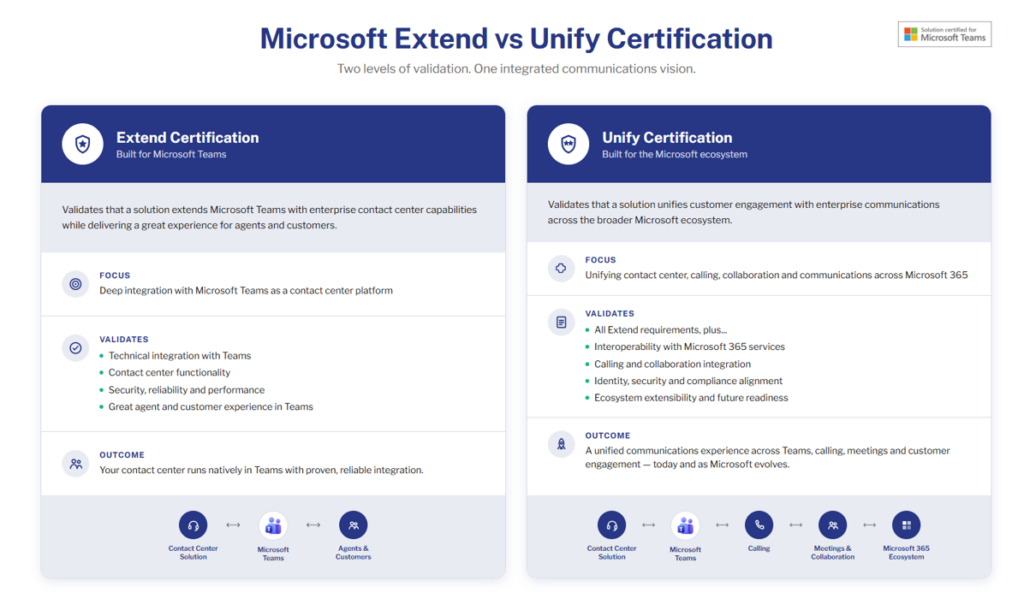
Both platforms have achieved Microsoft’s Extend certification. This certification confirms that they meet Microsoft’s requirements for extending Microsoft Teams with enterprise contact center capabilities while maintaining a consistent and familiar user experience.
Landis Contact Center has also achieved Microsoft’s Unify certification. While Extend focuses on integrating with Teams, Unify recognises solutions that are designed to unify enterprise communications and customer engagement across the broader Microsoft ecosystem. It demonstrates that Microsoft has independently validated the solution against a wider set of technical and interoperability requirements.
For you, that provides additional assurance that your contact center is aligned with Microsoft’s long-term vision for communications. As Teams, Copilot, and Microsoft 365 continue to evolve, certifications like Unify indicate that a solution has been built to work cohesively across Microsoft’s expanding platform rather than simply integrating with a single product.
Omnichannel Capabilities
Modern customers expect to contact your business through more than just voice. Whether they choose web chat, SMS, WhatsApp, or email, they expect a consistent experience and the ability to move between channels without repeating themselves.
Both Landis Contact Center and Luware Nimbus provide omnichannel capabilities that extend beyond traditional voice calls, but there are some notable differences in the channels they support.
| Channel | Landis Contact Center | Luware Nimbus |
|---|---|---|
| Voice | ✓ | ✓ |
| Web chat | ✓ | ✓ |
| Coming soon | ✓ | |
| SMS | ✓ | ✓ |
| ✓ | ✓ | |
| RCS | ✓ | ✗ |
Landis Contact Center supports voice, web chat, SMS, WhatsApp, and Rich Communication Services (RCS), with email support planned. The addition of RCS provides another option for businesses looking to adopt richer messaging experiences as mobile carriers continue to expand support for the standard.
Luware Nimbus currently supports voice, web chat, email, SMS, and WhatsApp, making it a strong choice if email is already a core part of your customer service operation.
For many contact centers, the practical differences between the two platforms will be minimal, as both cover the most commonly used digital channels. Your decision is more likely to come down to whether you need email today or whether you’re looking to take advantage of emerging messaging channels like RCS as they become more widely adopted.
AI Capabilities
Artificial intelligence is becoming one of the biggest differentiators between contact center platforms. Beyond automating customer interactions, AI can help your agents resolve issues faster, reduce manual administration, and provide supervisors with greater visibility into customer conversations.
Both Landis Contact Center and Luware Nimbus offer a comprehensive set of AI capabilities, with many features overlapping.
| AI Capability | Landis Contact Center | Luware Nimbus |
|---|---|---|
| Conversational AI | ✓ | AI Virtual Users |
| Agent Assist | ✓ | ✓ |
| AI-generated summaries | ✓ | ✓ |
| Call transcription | ✓ | ✓ |
| Speech analytics | ✓ | ✓ |
| Sentiment analysis | ✓ | ✓ |
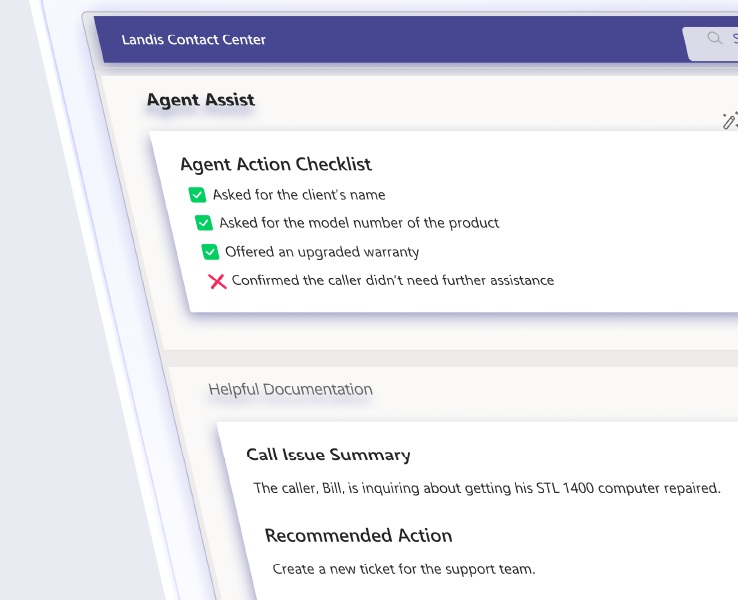
Landis Contact Center includes conversational AI, Agent Assist, AI-generated summaries, transcription, speech analytics, and sentiment analysis to help automate customer interactions and support agents throughout every conversation. These capabilities can reduce post-call administration, surface relevant information during live interactions, and help supervisors identify trends across customer conversations.
Luware Nimbus also provides a mature AI offering. AI Virtual Users automate customer interactions, while AI-generated summaries and transcription improve agent productivity. Its intelligent voice and AI speech analytics capabilities include sentiment analysis, allowing supervisors to identify customer emotions, monitor conversation quality, and gain deeper insight into agent performance.
When comparing the two platforms, there is less separation than might first appear. Both provide the core AI capabilities that most contact centers expect today, including conversational AI, transcription, summaries, and sentiment analysis.
Your decision is therefore more likely to come down to the maturity of each platform’s AI workflows, how deeply they integrate with your existing Microsoft environment, and the broader feature set offered by each vendor rather than the presence or absence of individual AI features.
Both Landis Contact Center and Luware Nimbus provide real-time and historical reporting, but they take slightly different approaches.
Reporting and Dashboards
| Reporting Capability | Landis Contact Center | Luware Nimbus |
|---|---|---|
| Real-time dashboards | ✓ | ✓ |
| Historical reporting | ✓ | ✓ |
| Wallboards | ✓ | ✓ |
| Scheduled reports | ✓ | ✓ |
| Call recordings | ✓ | ✓ |
| Transcript reporting | ✓ | ✓ |
| Power BI integration | ✓ | ✓ |
| OData access | ✗ | ✓ |
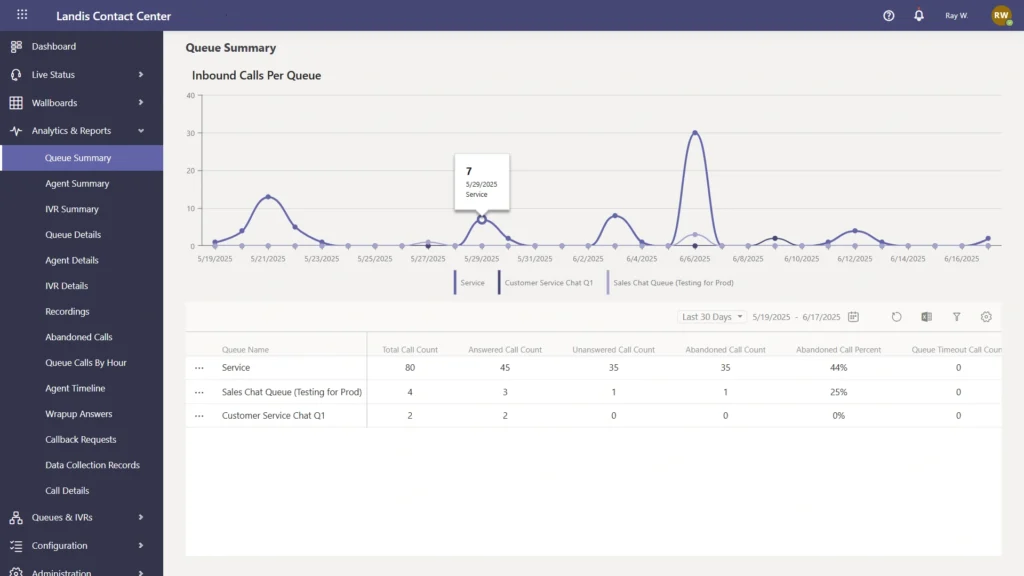
Landis Contact Center provides configurable dashboards, live wallboards, scheduled reports, and historical analytics that give supervisors visibility into contact center performance. Reporting extends beyond traditional call metrics to include conversation transcripts and AI-generated insights, helping you understand both operational performance and customer interactions.
Luware Nimbus offers a similarly comprehensive reporting experience with real-time dashboards, historical reports, scheduled reporting, and wallboards. One area where it differentiates itself is through native OData access and Power BI integration, making it easier to build custom dashboards and combine contact center data with information from other business systems.
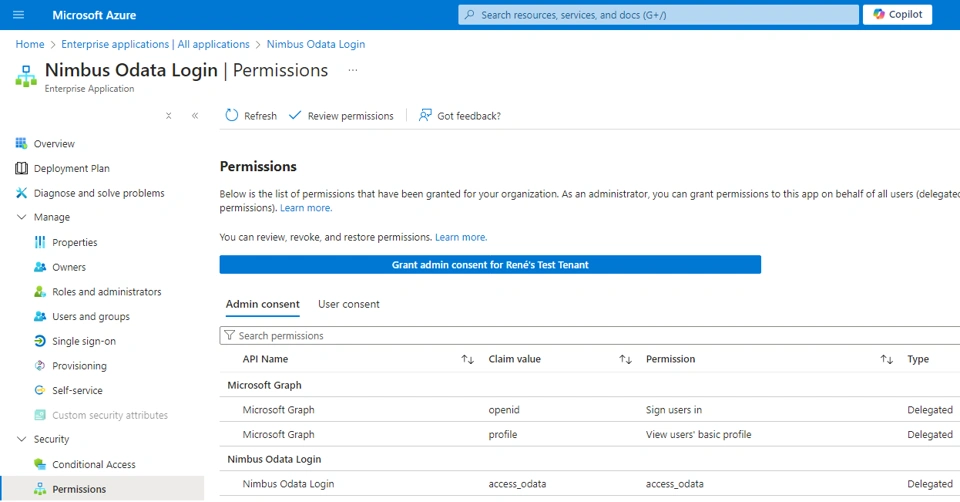
For most contact centers, both platforms deliver the reporting capabilities needed to monitor service levels, agent performance, and customer interactions. If your organization relies heavily on custom business intelligence dashboards or wants direct access to reporting data for enterprise analytics, Luware’s OData support may provide additional flexibility. Otherwise, both platforms offer a mature reporting experience suitable for day-to-day contact center management.
Workforce Management
Your agents are your greatest asset, so having the right workforce management tools is essential for maintaining service levels while controlling operational costs.
This is one area where the two platforms take noticeably different approaches.
| Workforce Management Capability | Landis Contact Center | Luware Nimbus |
|---|---|---|
| Native workforce management | Via Peopleware | — |
| Forecasting | ✓ | — |
| Scheduling | ✓ | — |
| Intraday management | ✓ | — |
| Adherence monitoring | ✓ | — |
| Capacity planning | ✓ | — |
Landis Contact Center integrates with Peopleware, a workforce management platform that helps you forecast demand, build schedules, monitor adherence, and optimize staffing levels. Together, the two solutions enable you to plan resources more effectively while maintaining service levels and improving agent productivity.
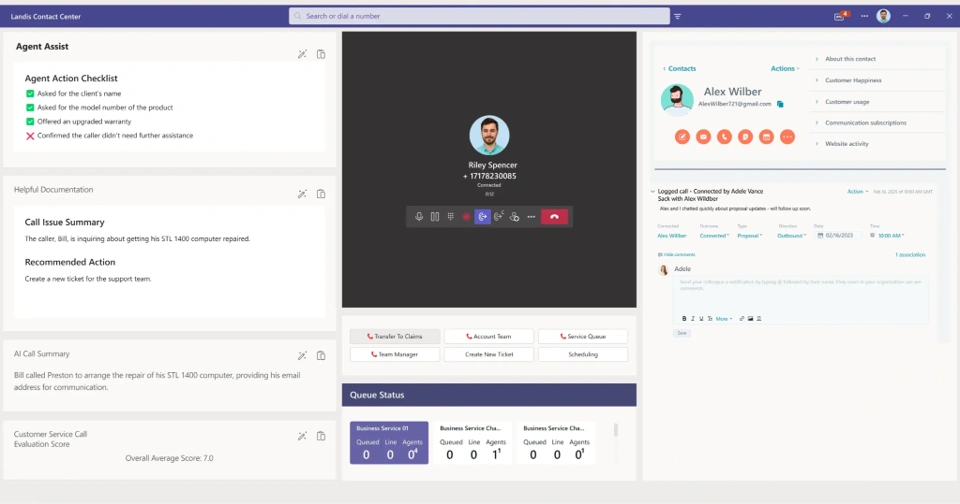
At the time of writing, Luware Nimbus does not publicly document a comparable native workforce management solution. Organizations that require forecasting, scheduling, or adherence management may need to integrate a third-party workforce management platform.
Landis Contact Center vs Luware Nimbus Pricing
At the time of writing, both vendors publish entry-level pricing for their enterprise contact center offerings.
| Platform | Starting Price |
|---|---|
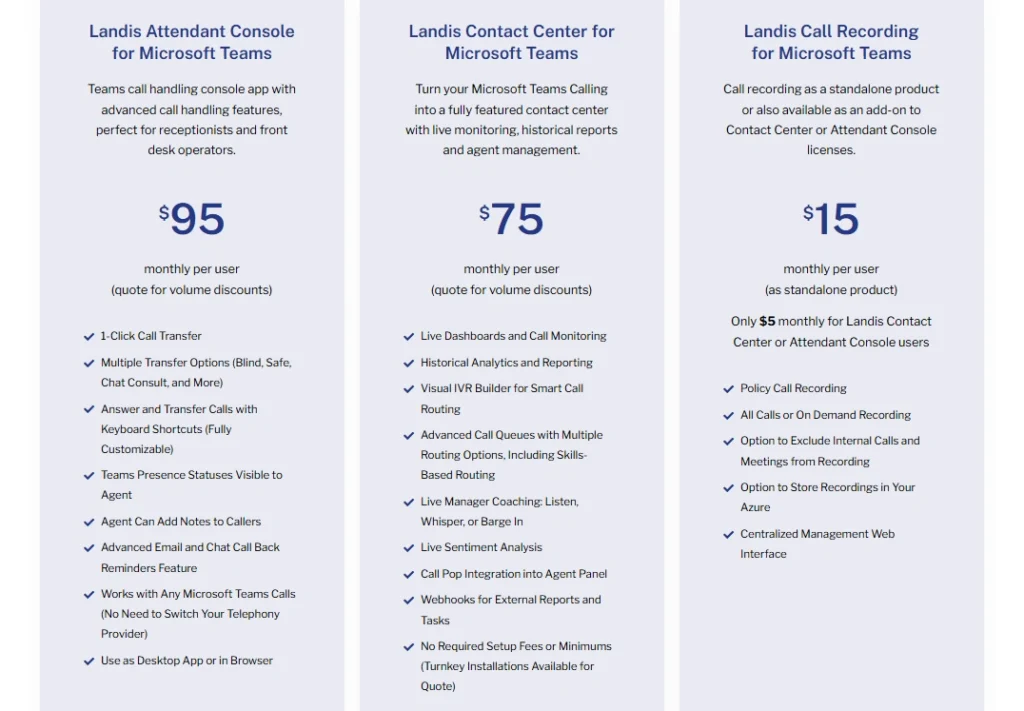
| Landis Contact Center | From USD 75 per user/month |
| Luware Nimbus | From USD 85 per user/month* |
* Published pricing applies to deployments of up to 199 users.
On published pricing alone, Landis Contact Center has a lower starting cost than Luware Nimbus. You can also see clear pricing for standalone attendant console and call recording licenses where needed.
Customer Reviews
Both Landis Contact Center and Luware receive positive feedback from customers, although reviewers tend to highlight different strengths.
Landis Contact Center
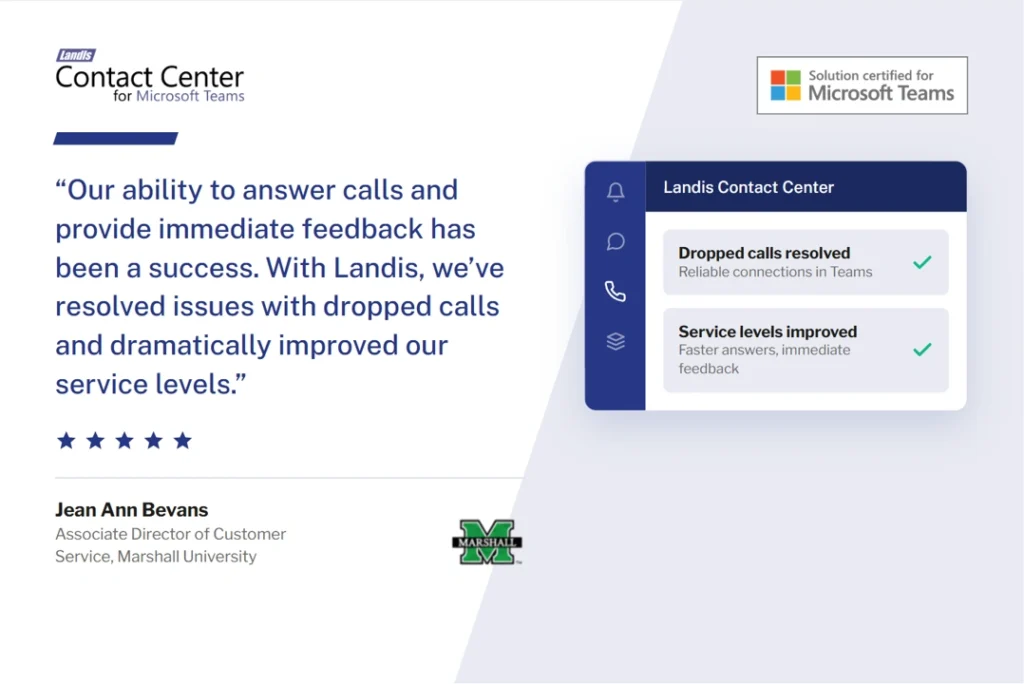
Customers consistently praise Landis for its Microsoft Teams-native experience, straightforward deployment, responsive support, and ease of use.
Rather than introducing another application for agents to learn, reviewers frequently highlight how naturally the platform fits into existing Teams environments.
Common themes include:
- Native Microsoft Teams experience
- Fast implementation
- Responsive customer support
- Intuitive user experience
- Reduced desktop switching for agents
Luware Nimbus
Luware Nimbus also receives strong customer feedback, with an average rating of 4.4 out of 5 on both G2 and Capterra at the time of writing. Reviewers consistently praise its Microsoft Teams integration, ease of implementation, and responsive support.
Common themes include:
- Deep Microsoft Teams integration
- Straightforward deployment and configuration
- Intuitive interface for agents and administrators
- Responsive customer support
- Comprehensive reporting and Power BI integration
- Strong automation capabilities
Reviewers also identify a few areas for improvement:
- Some advanced features require additional configuration.
- Certain administrative capabilities, like bulk user creation, could be improved.
- Some customers would like new features to be released more quickly.
- Pricing may be less competitive for smaller deployments.
Overall, customer sentiment for both platforms is overwhelmingly positive.
If your organization has standardized on Microsoft Teams, reviews suggest that both Landis Contact Center and Luware Nimbus deliver a familiar user experience, strong Microsoft integration, and responsive vendor support.
The differences are less about customer satisfaction and more about the specific capabilities, certifications, and pricing that best align with your requirements.
Pros and Cons of Landis and Luware
Every contact center has different priorities. The right choice depends on whether you value Microsoft’s highest level of certification, AI capabilities, omnichannel support, workforce management, or cost.
| Landis Contact Center | Luware Nimbus |
|---|---|
| Pros | Pros |
| Microsoft Extend and Unify certified | Microsoft Extend certified |
| Lower published starting price | Strong Microsoft Teams integration |
| Supports RCS messaging | Email support available today |
| Workforce management through Peopleware integration | |
| Cons | Cons |
| Email support is currently listed as coming soon | Higher published starting price |
| No publicly documented native workforce management offering | |
| Does not hold Microsoft’s Unify certification |
Neither platform has any major weaknesses, and both provide a modern contact center experience built around Microsoft Teams.
- Landis Contact Center stands out if you’re looking for Microsoft’s highest level of contact center certification, integrated workforce management, and a lower published starting price. It also offers a broad AI feature set and support for emerging messaging channels like RCS.
- Luware Nimbus is a capable alternative with good Teams integration, comprehensive CRM connectivity, email support, and strong customer reviews.
Should You Choose Landis Contact Center or Luware Nimbus?
Both Landis Contact Center and Luware Nimbus are excellent choices if you’re looking for a contact center built around Microsoft Teams. Each extends Teams with enterprise-grade capabilities, supports omnichannel customer engagement, and offers a mature set of AI, reporting, and integration features.
If your priority is aligning as closely as possible with Microsoft’s long-term vision for unified communications, Landis Contact Center has a clear advantage. It’s one of the few solutions to achieve both Microsoft’s Extend and Unify certifications, providing assurance that it has been independently validated against Microsoft’s highest standards for customer engagement within the Microsoft ecosystem. Combined with its lower published starting price and workforce management integration, it presents a compelling option for organizations planning for long-term growth.
Luware Nimbus is worthy of consideration, particularly if email is an important customer channel immediately. It has an established reputation among Microsoft customers, some strong user reviews, and a feature set that will meet the needs of many contact centers.
Ultimately, your decision should be based on more than a feature checklist. Consider how each platform aligns with your existing Microsoft investment, your customer engagement strategy, your operational requirements.
- If you’re heavily invested in Microsoft Teams and want a platform that combines enterprise contact center functionality with Microsoft’s highest level of certification, Landis Contact Center is likely to be the stronger choice.
- If your priorities include email as a contact center channel right away, Luware Nimbus remains a good alternative.
See Why Organizations Choose Landis Contact Center
Choosing a contact center isn’t just about today’s feature set. It’s about investing in a platform that will continue to evolve alongside Microsoft Teams and the wider Microsoft ecosystem.
Landis Contact Center combines enterprise-grade customer engagement with Microsoft’s Extend and Unify certifications, helping you deliver exceptional customer experiences while keeping your agents productive in the tools they already use.
Book your personalized demonstration to see how Landis Contact Center can help you modernize your contact center, streamline customer interactions, and get more from your Microsoft investment.