
By Dominic Kent
Dominic Kent is an independent writer who specializes in unified communications and contact center technology. He runs UC Marketing Ltd, a consultancy dedicated to helping technology companies translate complex technology products into compelling stories and educational content. His projects often involve well-researched guides that speaks to IT leaders and business stakeholders alike.
Table of contents
- Landis Contact Center vs Webex Contact Center at a Glance
- What Is Landis Contact Center?
- What Is Webex Contact Center?
- Landis Contact Center vs Webex Contact Center: Feature Comparison
- Landis Contact Center vs Webex Contact Center: Pricing
- Landis Contact Center vs Webex Contact Center: Which Is Best for Microsoft Teams?
- There’s No Need to Introduce a New Platform
Webex Contact Center is one of the most established cloud contact center platforms on the market. But if your organization has standardized on Microsoft Teams, the question isn’t whether Webex is a capable contact center. It’s whether it’s the right fit for your Microsoft environment.
Landis Contact Center and Webex Contact Center both offer AI-powered customer engagement, omnichannel communications, reporting, and workforce management. The difference lies in how they integrate with Microsoft Teams and the wider Microsoft ecosystem.
In this comparison, you’ll learn how Landis Contact Center and Webex Contact Center compare across Teams integration, AI capabilities, omnichannel support, reporting, pricing, workforce management, and customer reviews, helping you decide which platform is the better choice for your Microsoft Teams setup.
Landis Contact Center vs Webex Contact Center at a Glance
| Category | Landis Contact Center | Webex Contact Center |
|---|---|---|
| Microsoft Teams integration | Built to extend Microsoft Teams with Microsoft Extend and Unify certification | Integrates with Microsoft Teams alongside the Cisco ecosystem |
| Omnichannel capabilities | Voice, web chat, SMS, WhatsApp, RCS, email (coming soon) | Voice, email, web chat, SMS, social messaging, and digital channels |
| AI capabilities | Conversational AI, Agent Assist, transcription, summaries, speech analytics, sentiment analysis | AI Agent, AI Assistant, transcription, summaries, speech analytics, sentiment analysis |
| Reporting and analytics | Real-time dashboards, historical reporting, Power BI integration | Real-time dashboards, Analyzer reporting, historical analytics |
| Workforce management | Peopleware workforce management integration | Native Webex Workforce Optimization available |
| Microsoft certifications | Microsoft Extend and Unify | Microsoft Extend |
| Starting price | From $75/user/month | No public pricing but reportedly: Standard from $99/agent/month and Premium from $150/agent/month (annual commitment) |
What Is Landis Contact Center?
Landis Contact Center is a cloud-native contact center platform built specifically for Microsoft Teams. It extends Teams with the tools you need to manage customer interactions while allowing agents to work from the familiar Microsoft interface they already use every day.
The platform supports inbound and outbound voice, web chat, SMS, WhatsApp, RCS, and email (coming soon). It also includes AI-powered capabilities like conversational AI, Agent Assist, speech analytics, sentiment analysis, call transcription, and AI-generated conversation summaries to help agents resolve customer enquiries more efficiently.
Beyond customer engagement, Landis provides real-time and historical reporting, Power BI integration, and workforce management through its integration with Peopleware. It also integrates with business applications like Microsoft Dynamics 365, Salesforce, HubSpot, ServiceNow, Microsoft Power Apps, and Microsoft Power Automate.
Unlike contact center platforms that add Microsoft Teams as another integration option, Landis is built around the Microsoft ecosystem. It has achieved both Microsoft’s Extend and Unify certifications, reflecting its deep integration with Microsoft’s communications platform and long-term product strategy.
Why Microsoft’s Extend and Unify Certifications Matter
If you’re investing in a contact center for Microsoft Teams, Microsoft’s certification program is more than worth paying attention to. It helps distinguish platforms that simply connect to Teams from those that are designed to work alongside Microsoft’s communications strategy.
Microsoft introduced the Extend certification to recognize contact center providers that enhance Teams with enterprise customer engagement capabilities. Solutions that achieve Extend certification integrate with Teams while maintaining a familiar user experience and meeting Microsoft’s technical and security requirements.
As Microsoft’s vision for enterprise communications evolved, it introduced the Unify certification. Unify builds on the Extend requirements and recognizes solutions that deliver deeper integration across the Microsoft ecosystem, supporting Microsoft’s long-term strategy for unified communications and customer engagement.
Landis Contact Center has achieved both Microsoft Extend and Unify certifications, while Webex Contact Center has achieved Microsoft Extend certification.
For IT and telephony teams, deeper integration means less to own and fewer vendors to chase:
- No SBCs, Direct Routing, or servers to stand up. Agents are provisioned as ordinary Teams users
- One accountable support path
- Call media and data stay inside your Microsoft tenant, under the security and compliance rules you already enforce
- A single admin surface centered in Teams, instead of a separate portal bolted onto Direct Routing
For contact center operations, deeper integration means fewer missed calls and metrics that survive the move:
- Agents answer in the Teams window they already keep open all day without a separate app to forget to log into
- Routing reads Teams presence, so an agent already in a meeting is skipped automatically and wallboards reflect live metrics
- Agents can loop in a subject-matter expert or transfer to any colleague in Teams without dropping call history and notes
- Live monitoring, dashboards, and reporting sit in one place, so service levels hold through cutover instead of eroding after it
Certification alone shouldn’t determine your purchasing decision, but it does provide extra confidence that a platform has been developed in line with Microsoft’s expectations for security, interoperability, and the future direction of Teams.
If your organization has standardized on Microsoft Teams, those certifications are an important consideration when comparing contact center platforms.
A Long History of Building for Microsoft
One of Landis’ biggest differentiators is its long-standing investment in Microsoft’s communications platforms.
From the beginning, it’s built software that integrates deeply with Microsoft technologies, evolving alongside Microsoft’s unified communications strategy from Lync to Skype for Business and now Microsoft Teams.
Rather than entering the Teams contact center market after Teams became mainstream, Landis had already established years of experience developing Microsoft-integrated communications software.
Microsoft Timeline
- 2014: Released Attendant Pro for Microsoft Lync, helping organizations manage high volumes of inbound calls.
- 2017: Updated Attendant Pro for Skype for Business, ensuring customers could continue supporting Microsoft’s evolving communications platform.
- 2020: Released Policy Call Recording for Microsoft Teams, expanding its growing Microsoft Teams portfolio.
- 2021: Released one of the first Microsoft Teams contact center solutions built on Microsoft’s Extend integration model, followed shortly by its Microsoft Teams Attendant Console.
- 2024: Worked closely with Microsoft to help develop APIs for the new Unify integration model.
- 2025: Became one of the first contact center vendors globally to achieve Microsoft Teams Unify certification.
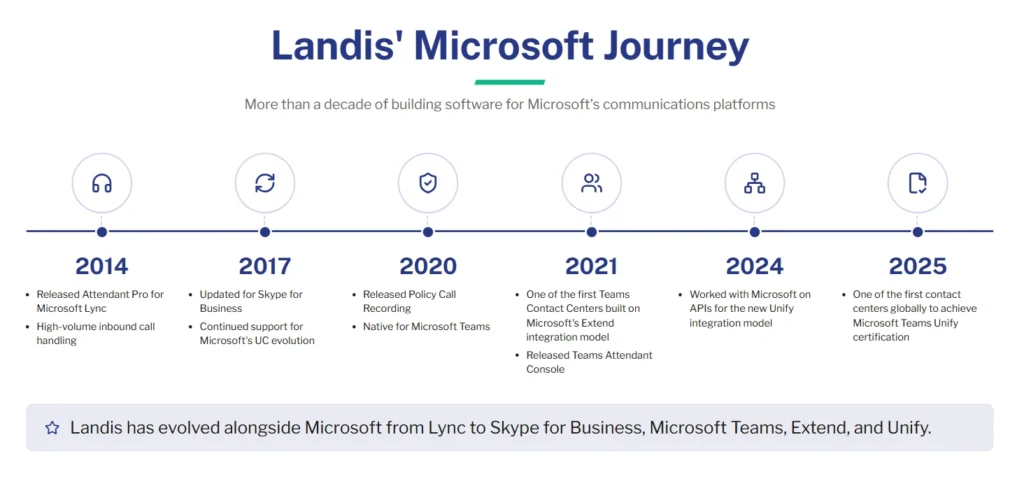
This progression demonstrates consistent investment in Microsoft’s communications ecosystem for more than a decade. As Microsoft introduced new platforms and integration models, Landis continued evolving its products to align with Microsoft’s latest architecture.
What Is Webex Contact Center?
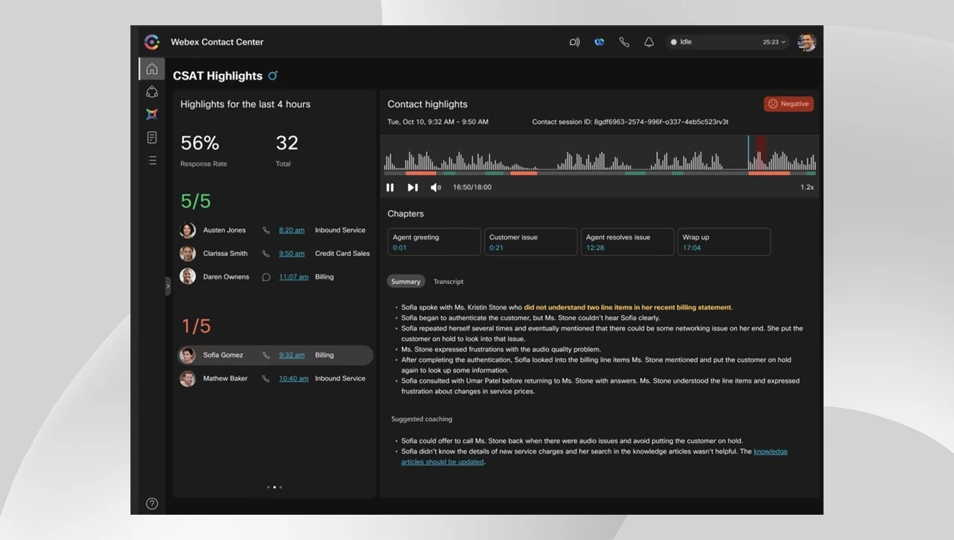
Webex Contact Center is Cisco’s cloud contact center platform and part of the broader Webex Customer Experience portfolio. Its main customer base is existing Cisco customers using both on-premises and cloud telephony setups as well as the wider security and networking portfolio.
The platform supports voice, email, web chat, SMS, WhatsApp, Facebook Messenger, and Apple Messages for Business. It also includes AI capabilities, workforce optimization, quality management, call recording, reporting, and analytics.
For organizations already invested in the Cisco ecosystem, Webex Contact Center provides a natural extension of existing Webex deployments. For Microsoft Teams customers, however, it remains a third-party integration rather than a platform built specifically for the Microsoft ecosystem.
Landis Contact Center vs Webex Contact Center: Feature Comparison
Microsoft Teams Integration
If your organization has standardized on Microsoft Teams, integration should be one of the first factors you evaluate. While both platforms integrate with Teams, they take different approaches.
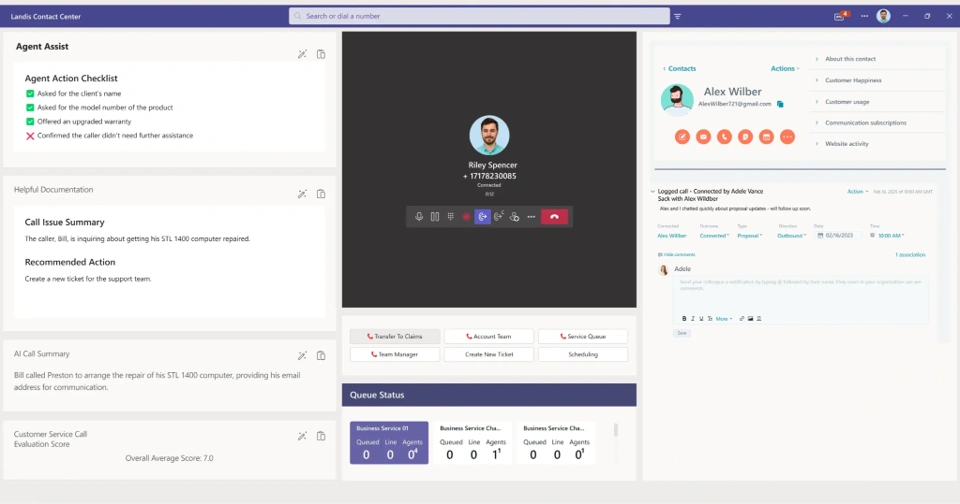
Landis Contact Center is built specifically for Microsoft Teams. Agents manage customer interactions from within Teams using the collaboration tools they already use every day. The platform has achieved both Microsoft’s Extend and Unify certifications, reflecting its deep integration with the Microsoft ecosystem.
Webex Contact Center also integrates with Microsoft Teams and has achieved Microsoft’s Extend certification. However, it’s designed as part of Cisco’s broader customer experience portfolio rather than around Teams itself. Organizations already using Webex Calling and other Cisco collaboration products may benefit from a more consistent experience across the Cisco ecosystem.
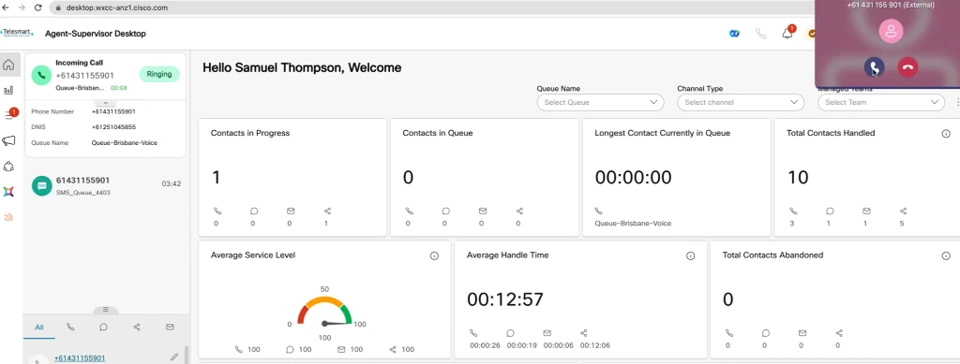
If Microsoft Teams is your primary communications platform, Landis provides the deeper Microsoft integration. If your organization is more heavily invested in Cisco technologies, Webex Contact Center may be the better fit.
Administration and Management
The differences between the two platforms become more apparent from an administrative perspective.
Landis Contact Center enables organizations to manage their Microsoft Teams telephony and contact center environment from within the Microsoft ecosystem, reducing the need to switch between multiple management portals. This simplifies day-to-day administration for IT teams that have standardized on Microsoft technologies.
Webex Contact Center is administered through Webex Control Hub. While this provides a centralized management experience for Cisco deployments, Microsoft Teams customers must manage their collaboration platform in Microsoft and their contact center platform in Cisco.
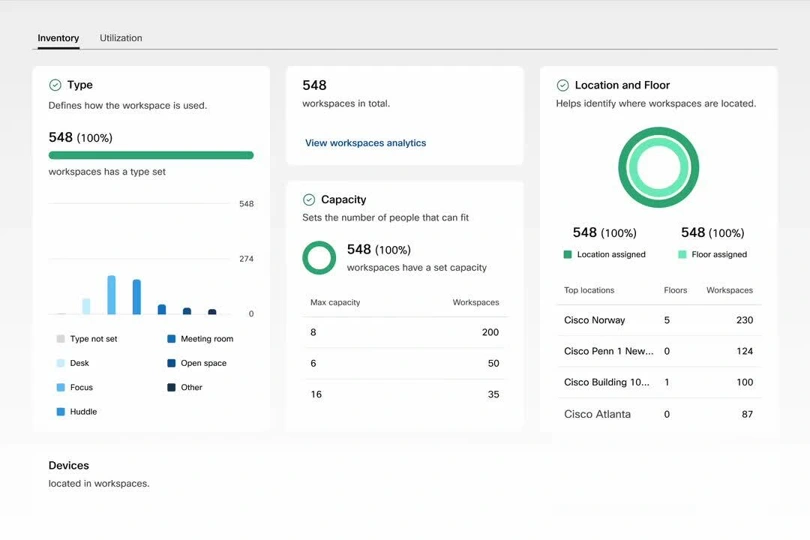
For organizations looking to consolidate administration around Microsoft Teams, this introduces an additional management interface and operational overhead.
Omnichannel Capabilities
Customers expect to communicate through the channel that’s most convenient for them, making omnichannel support an essential feature for modern contact centers.
Landis Contact Center supports inbound and outbound voice, web chat, SMS, WhatsApp, RCS, and email (coming soon). Conversations can be routed through a single platform (Teams), giving agents the context they need to deliver a more consistent customer experience.
Webex Contact Center supports voice, email, web chat, SMS, WhatsApp, Facebook Messenger, and Apple Messages for Business.
- If a Microsoft-first experience is a priority, Landis has the advantage.
- If your organization relies on channels like Apple Messages for Business, Webex Contact Center currently offers broader channel support via its extended CPaaS platform.
AI Capabilities
You’ll find a lot of match-ups when comparing AI features in contact center platforms. Every vendor is fighting a constant battle to provide the same functionality in what has very quickly become a race to the bottom on functionality vs price.
The better way to approach this comparison is by identifying your specific AI use case and understanding how the platform serves this.
Landis Contact Center includes:
- Conversational AI
- Agent Assist
- Speech analytics
- Sentiment analysis
- Call transcription
- AI-generated conversation summaries
These capabilities help agents resolve enquiries more efficiently by providing real-time guidance and reducing manual work after each interaction.
Webex Contact Center offers:
- AI Agents
- AI Assistants
- Speech analytics
- Sentiment analysis
- Call transcription
- AI-generated summaries
One unique feature in Webex is Agent Reset, an AI-powered wellbeing feature that detects signs of agent stress and can present a short personalized reset experience using an agent’s preferred music, images, or videos before the next customer interaction.
This is a neat feature for large call centers handling tremendous call volume. But you might argue you shouldn’t need this if employee wellbeing is already a priority.
If your priority is AI that enhances a Microsoft Teams deployment, Landis provides the capabilities most organizations need. Webex offers a comparable AI feature set while differentiating itself with Agent Reset for employee wellbeing.
Reporting and Analytics
Both platforms provide real-time and historical reporting, but they differ in how that information is surfaced and extended.
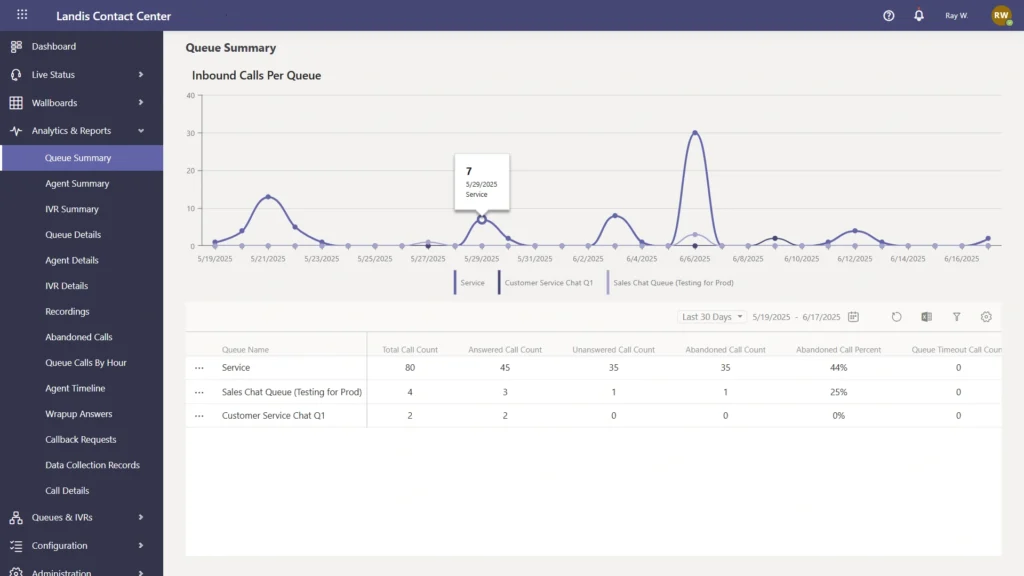
Landis Contact Center includes real-time dashboards, historical reporting, and native integration with Microsoft Power BI. This allows organizations already using Microsoft’s data platform to combine contact center metrics with wider business intelligence, creating tailored dashboards and reports without introducing another analytics ecosystem.
Webex Contact Center provides real-time dashboards alongside historical reporting through Cisco Analyzer. Organizations already invested in Cisco’s customer experience platform can use these tools to monitor agent performance, customer interactions, and operational trends.
Both platforms deliver the reporting capabilities most organizations expect.
- If your business already relies on Microsoft Power BI or Teams call queues for reporting, Landis offers a more natural fit.
- Organizations with established Cisco reporting workflows may prefer the analytics available within the Webex ecosystem.
Landis Contact Center vs Webex Contact Center: Pricing
| Category | Landis Contact Center | Webex Contact Center |
|---|---|---|
| Starting price | From $75 per user/month | Standard Named Agent from approximately $99 per user/monthPremium Named Agent from approximately $150 per user/month* |
| Licensing | Simple per-user licensing | Multiple editions with named agent licensing |
| Procurement | Purchased directly from Landis | Purchased through Cisco partners |
| Platform alignment | Built for Microsoft Teams | Built for the Cisco ecosystem |
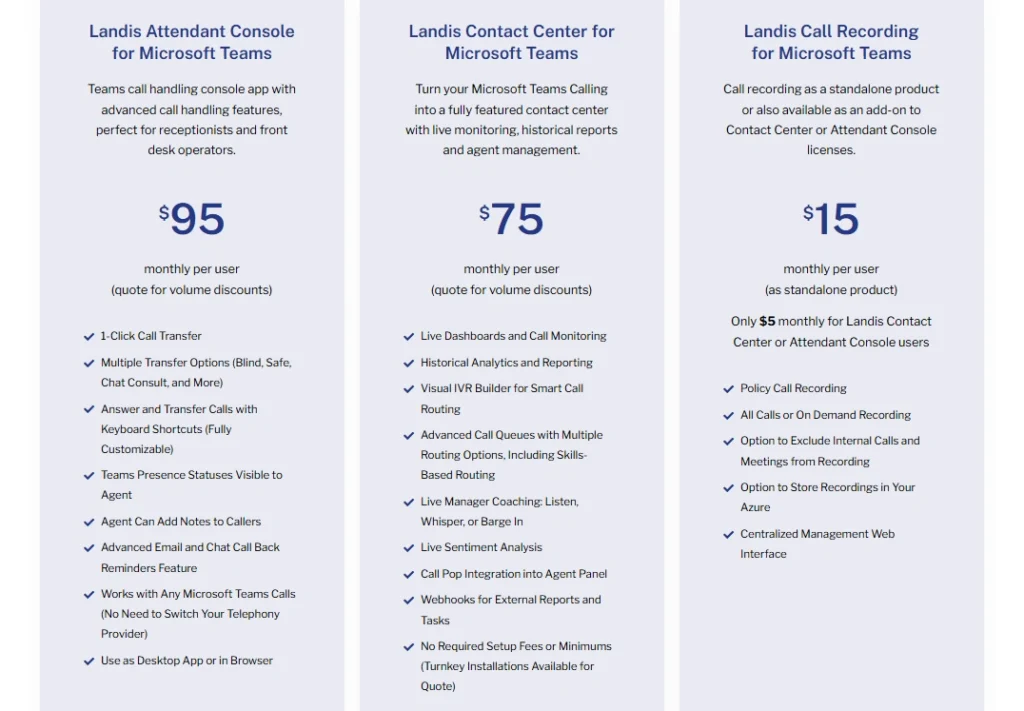
Landis pricing starts at $75 per user/month, which is equivalent to $900 per user/year.
You can also see clear pricing for standalone attendant console and call recording licenses where needed.
Webex Contact Center pricing varies depending on the edition, deployment size, and wider Cisco licensing agreements.
When evaluating total cost of ownership, it’s also worth considering the operational impact.
Landis keeps users and administrators within the Microsoft ecosystem, while Webex Contact Center requires organizations to manage Microsoft Teams alongside Cisco’s Webex Control Hub. For Microsoft-first organizations, this introduces an additional management platform that can increase administrative overhead beyond the monthly license cost.
Landis Contact Center vs Webex Contact Center: Which Is Best for Microsoft Teams?
The right choice depends on whether your organization is built around Microsoft Teams or Cisco.
- Choose Landis Contact Center if you’ve standardized on Teams and you want a contact center that extends your existing investment. Agents work within Teams, administrators remain in the Microsoft ecosystem, and the platform has achieved both Microsoft’s Extend and Unify certifications. Combined with a lower starting price, this makes Landis a compelling choice for organizations looking to simplify administration and maximize their Microsoft investment.
- Choose Webex Contact Center if you’ve standardized on Cisco collaboration technologies. Its AI capabilities, broad digital channel support, and native Cisco management experience make it a strong option for businesses committed to the Cisco ecosystem.
For organizations evaluating contact centers specifically for Microsoft Teams, Landis delivers the more integrated experience.
Rather than adding another platform to manage, it extends the collaboration environment your users and administrators already know, reducing complexity while providing the enterprise contact center capabilities growing organizations need.
There’s No Need to Introduce a New Platform
If you’ve standardized on Microsoft Teams, your contact center shouldn’t require a second ecosystem to administer.
Landis Contact Center keeps agents in Teams, keeps administrators inside Microsoft 365, and delivers the enterprise capabilities you’d expect from a modern cloud contact center.
Want to see how Landis compares in your environment?
Get a personalized demo and discover how you can simplify administration, reduce complexity, and get more from your Microsoft Teams investment.