
By Dominic Kent
Dominic Kent is an independent writer who specializes in unified communications and contact center technology. He runs UC Marketing Ltd, a consultancy dedicated to helping technology companies translate complex technology products into compelling stories and educational content. His projects often involve well-researched guides that speaks to IT leaders and business stakeholders alike.
Table of contents
When evaluating Microsoft Teams contact center solutions, Landis Contact Center and AudioCodes Voca are two platforms that often make the shortlist. Both are Microsoft-certified solutions designed to enhance customer service within Microsoft Teams, but they take different approaches to delivering that experience.
Landis has been specializing in the Microsoft Teams customer experience space since 2014 and is focused exclusively on inbound communications management within Microsoft Teams. Its product portfolio is built around helping organizations deliver exceptional customer interactions through Teams-native contact center and communications solutions.
AudioCodes, meanwhile, comes with a broader product portfolio but it ismuch newer to the Teams contact center space. Alongside Voca Contact Center, the company offers session border controllers (SBCs), voice gateways, IP phones, meeting room solutions, conversational AI, and enterprise voice infrastructure.
For organizations already using Microsoft Teams, both platforms offer omnichannel customer engagement, intelligent call routing, reporting, and AI-powered capabilities. However, they differ in several important areas, including deployment, administration, product focus, customization, and the overall user experience.
This guide compares Landis Contact Center and AudioCodes Voca across the areas that matter most to buyers, including Microsoft Teams integration, core features, AI capabilities, reporting, pricing considerations, customer reviews, and the types of organizations each solution is best suited for.
By the end of this comparison, you’ll have a clearer understanding of which platform best aligns with your organization’s customer experience goals.
Landis Contact Center vs AudioCodes Voca at a Glance
If you’re comparing Landis Contact Center and AudioCodes Voca, both platforms deliver enterprise-grade contact center capabilities for Microsoft Teams. However, they differ in their product focus, deployment philosophy, and ideal customer profile.
The table below provides a high-level overview before we explore each area in more detail.
| Feature | Landis Contact Center | AudioCodes Voca |
|---|---|---|
| Primary focus | Pioneering Microsoft Teams contact center and customer experience solutions | Enterprise communications platform with contact center capabilities |
| Microsoft Teams integration | Native Microsoft Teams integration | Native Microsoft Teams integration |
| Deployment | Cloud-based | Cloud and hybrid deployment options |
| Omnichannel support | Voice, web chat, email, SMS, WhatsApp, social messaging, conversational AI agents | Voice, digital channels, messaging and conversational AI |
| IVR | ✓ | ✓ |
| Skills-based routing | ✓ | ✓ |
| AI capabilities | AI-powered routing, transcription, summaries and intelligent automation, conversational AI, and virtual agents. | Conversational AI, voice bots, virtual agents and AI-assisted routing |
| Real-time dashboards | ✓ | ✓ |
| Supervisor tools | ✓ | ✓ |
| CRM integrations | Microsoft Dynamics 365, Salesforce and other business applications | Microsoft Dynamics 365, Salesforce and other leading CRMs |
| Microsoft certification | Certified for Microsoft Teams Extend and Unify | Certified for Microsoft Teams Unify only |
| Best suited for | Organizations seeking a purpose-built Microsoft Teams contact center | Organizations looking for a broader enterprise communications ecosystem |
Key Takeaways
Both solutions provide the core capabilities organizations expect from a modern Microsoft Teams contact center, including intelligent routing, omnichannel engagement, reporting, and AI-powered customer experiences.
The biggest difference lies in each vendor’s strategic focus.
Landis concentrates its development on Microsoft Teams customer experience solutions, giving organizations a platform purpose-built for contact center operations within the Microsoft ecosystem.
AudioCodes approaches the market from a broader enterprise communications perspective. Alongside Voca, the company develops a wide range of communications technologies, including SBCs, gateways, IP phones, meeting room devices, and conversational AI solutions.
Understanding which is better depends on your specific use case, industry requirements, or if there are point features that are make or break. Let’s break down each and see which excels where.
What Is Landis Contact Center?
Landis Contact Center is a Microsoft Teams-native contact center platform that helps organizations manage customer interactions across voice and digital channels. Built specifically for Microsoft Teams, it enables agents to handle customer conversations without leaving the Teams interface.
The platform is designed for organizations that want to replace legacy contact center infrastructure with a cloud-based solution that integrates deeply with Microsoft 365. Rather than treating Teams as another integration, Landis has built its customer experience platform around Microsoft’s communications ecosystem.
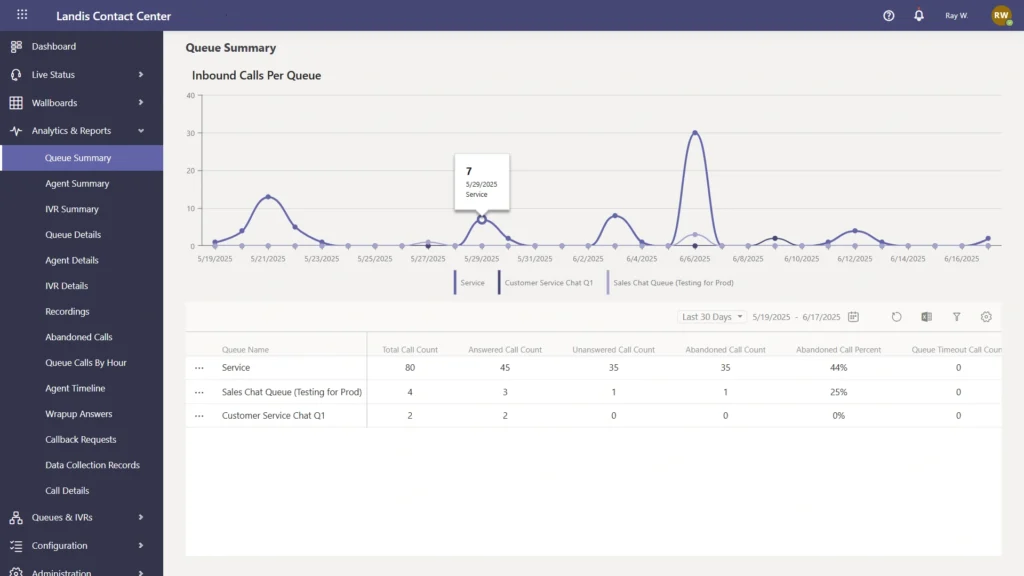
Landis Contact Center includes capabilities like intelligent call routing, interactive voice response (IVR), omnichannel engagement, AI-powered automation, real-time reporting, supervisor tools, and CRM integrations with platforms like Microsoft Dynamics 365 and Salesforce. The platform is available as a cloud solution and is certified for Microsoft Teams.
Unlike many contact center vendors, Landis focuses exclusively on Microsoft Teams customer experience solutions. That specialization has shaped the company’s product roadmap for more than a decade.
A Long History of Building for Microsoft
One of Landis’ biggest differentiators is its long-standing investment in Microsoft’s communications platforms.
From the beginning, it’s built software that integrates deeply with Microsoft technologies, evolving alongside Microsoft’s unified communications strategy from Lync to Skype for Business and now Microsoft Teams.
Rather than entering the Teams contact center market after Teams became mainstream, Landis had already established years of experience developing Microsoft-integrated communications software.
Microsoft Timeline
- 2014: Released Attendant Pro for Microsoft Lync, helping organizations manage high volumes of inbound calls.
- 2017: Updated Attendant Pro for Skype for Business, ensuring customers could continue supporting Microsoft’s evolving communications platform.
- 2020: Released Policy Call Recording for Microsoft Teams, expanding its growing Microsoft Teams portfolio.
- 2021: Released one of the first Microsoft Teams contact center solutions built on Microsoft’s Extend integration model, followed shortly by its Microsoft Teams Attendant Console.
- 2024: Worked closely with Microsoft to help develop APIs for the new Unify integration model.
- 2025: Became one of the first contact center vendors globally to achieve Microsoft Teams Unify certification.
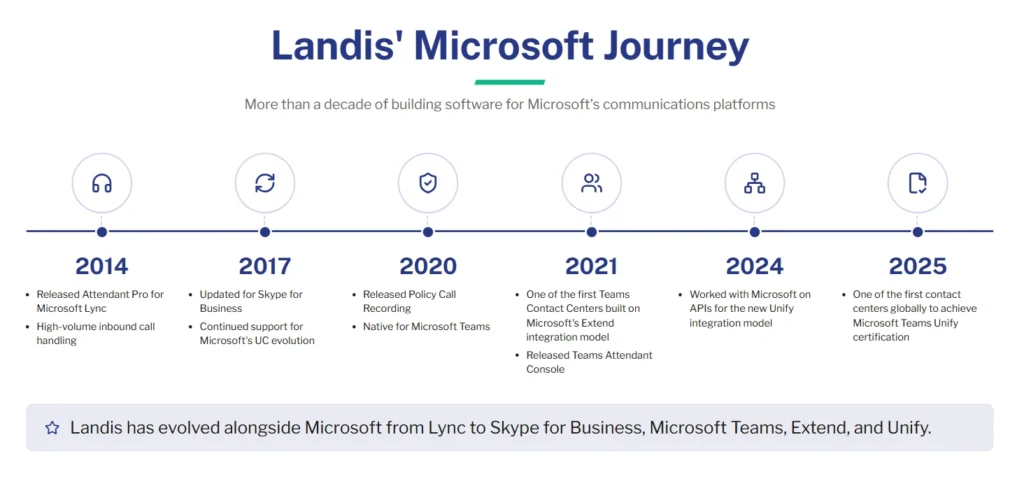
This progression demonstrates consistent investment in Microsoft’s communications ecosystem for more than a decade. As Microsoft introduced new platforms and integration models, Landis continued evolving its products to align with Microsoft’s latest architecture.
For organizations that have standardized on Microsoft Teams, that history demonstrates a sustained commitment to Microsoft’s ecosystem rather than a recent expansion into the contact center market.
Why Microsoft’s Extend and Unify Certifications Matter
Microsoft certifies contact centers using different integration models. While some platforms are certified under the Connect model, Landis is certified for both the Extend and Unify integration models.
The three models are degrees of how deeply the contact center lives inside Microsoft Teams. Connect bridges an outside platform to Teams over Direct Routing; Extend and Unify build the contact center into Teams itself. The closer it gets to native Teams, the more it changes the day-to-day.
For IT and telephony teams, deeper integration means less to own and fewer vendors to chase:
- No SBCs, Direct Routing, or servers to stand up. Agents are provisioned as ordinary Teams users
- One accountable support path
- Call media and data stay inside your Microsoft tenant, under the security and compliance rules you already enforce
- A single admin surface centered in Teams, instead of a separate portal bolted onto Direct Routing
For contact center operations, deeper integration means fewer missed calls and metrics that survive the move:
- Agents answer in the Teams window they already keep open all day without a separate app to forget to log into
- Routing reads Teams presence, so an agent already in a meeting is skipped automatically and wallboards reflect live metrics
- Agents can loop in a subject-matter expert or transfer to any colleague in Teams without dropping call history and notes
- Live monitoring, dashboards, and reporting sit in one place, so service levels hold through cutover instead of eroding after it
While every organization has different requirements, Microsoft’s certification models represent different approaches to Teams integration. Landis’ Extend and Unify certifications demonstrate that it supports Microsoft’s more advanced integration models rather than relying solely on the Connect approach.
Landis Contact Center Key Features
- Microsoft Teams-native contact center
- Intelligent and skills-based call routing
- Interactive Voice Response (IVR)
- Omnichannel customer engagement
- AI-powered automation and agent assistance
- Supervisor monitoring and coaching
- Real-time dashboards and analytics
- CRM integrations with platforms like Microsoft Dynamics 365 and Salesforce
- Cloud-native deployment
- Microsoft Teams certified
Pros
- Purpose-built for Microsoft Teams
- More than a decade of experience developing Microsoft-integrated communications software
- Focused exclusively on Microsoft Teams customer experience solutions
- Keeps agents working within the Microsoft Teams interface
- Cloud-native architecture
- Regularly updated to align with Microsoft’s latest integration models
Considerations
- Best suited for organizations that have standardized on Microsoft Teams.
- Organizations looking for a broader unified communications portfolio may prefer vendors that offer additional enterprise voice and networking products alongside their contact center solution.
What Is AudioCodes Voca?
AudioCodes Voca is a Microsoft Teams-certified contact center platform that helps organizations manage customer interactions across voice and digital channels. It includes capabilities like omnichannel engagement, intelligent call routing, IVR, AI-powered virtual agents, analytics, and CRM integrations.
Unlike Landis, Voca is part of a much broader enterprise communications portfolio. AudioCodes has spent decades developing technologies that include session border controllers (SBCs), voice gateways, IP phones, meeting room solutions, conversational AI, voice networking, and managed services. Voca extends that portfolio by providing contact center capabilities for organizations using Microsoft Teams.
The platform is available as a cloud solution and integrates with Microsoft Teams while supporting organizations that want to combine contact center capabilities with a broader communications ecosystem. AudioCodes also places a strong emphasis on conversational AI, offering voice bots and virtual agents that can automate routine customer interactions before escalating conversations to live agents.
For organizations already using other AudioCodes technologies, Voca can become part of a wider communications strategy spanning enterprise voice, Microsoft Teams, AI, and customer experience.
Audiocodes Voca Key Features
- Microsoft Teams-certified contact center
- Omnichannel customer engagement
- Intelligent and skills-based call routing
- IVR
- AI-powered virtual agents and voice bots
- Real-time dashboards and reporting
- Supervisor monitoring and coaching tools
- CRM integrations with platforms like Microsoft Dynamics 365 and Salesforce
- Cloud deployment
- Part of the wider AudioCodes communications portfolio
Pros
- Broad enterprise communications portfolio
- Strong Microsoft Teams integration
- AI-powered self-service capabilities
- Suitable for organizations already invested in the AudioCodes ecosystem
- Extensive experience in enterprise voice and communications
Considerations
- Contact center is one part of a much broader communications portfolio.
- Organizations looking for a vendor focused exclusively on Microsoft Teams customer experience may prefer a specialist provider.
Landis vs AudioCodes Feature Comparison
When you compare them feature by feature, Landis is the simpler, more Teams-centric option, while AudioCodes Voca is stronger for deeper AI, broader omnichannel coverage, and enterprise scale. Both cover the core contact center basics, but they diverge once you look at automation, channel breadth, and deployment flexibility.
Microsoft Teams integration
- Landis: Landis is built as an embedded Microsoft Teams experience. Agents work inside the Teams client, making it feel familiar and fast to adopt, especially for organizations that want to keep workflows closely aligned with Microsoft 365.
- Voca: AudioCodes Voca is also Microsoft Teams-certified. It’s designed as part of a broader enterprise communications stack, making it a good fit for organizations that want contact center functionality alongside a wider voice and infrastructure strategy.
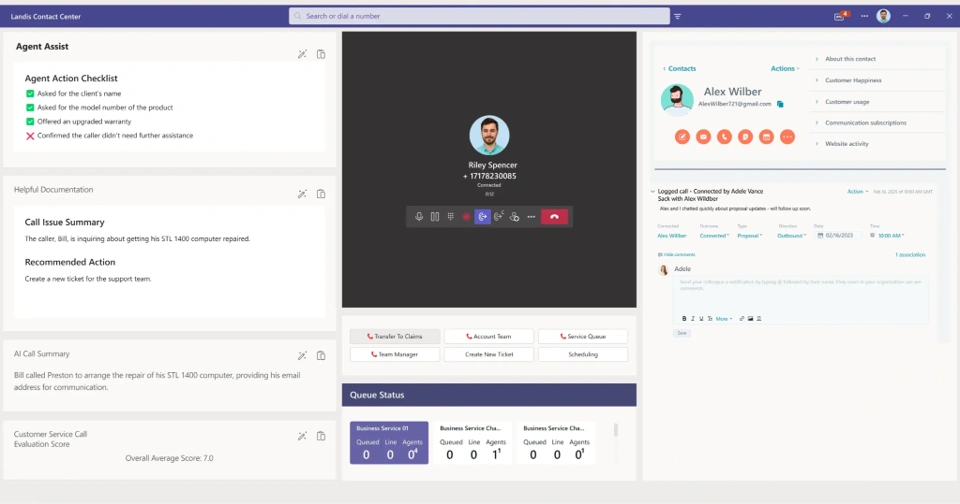
- Landis: Offers practical AI features like transcription, sentiment analysis, AI-assisted routing, and Copilot Studio chatbots. These are described as lightweight and easy to use by customers. Includes LLM-powered conversational AI, AI IVR, virtual agents, generative call summaries, and multilingual sentiment analysis.
- Voca: Provides the above in a more configurable manner, often attached to more complex telephony deployments.
Omnichannel support
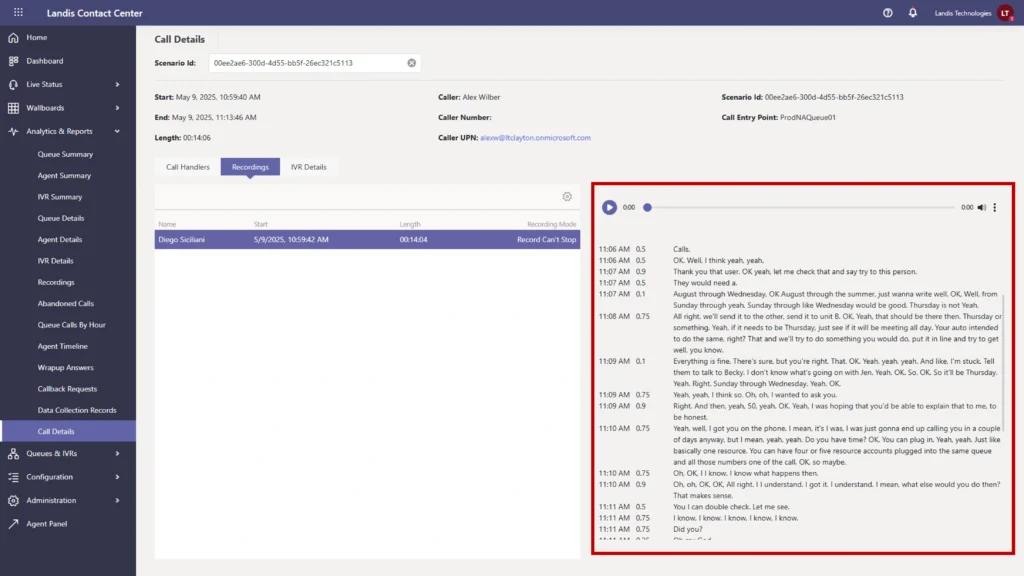
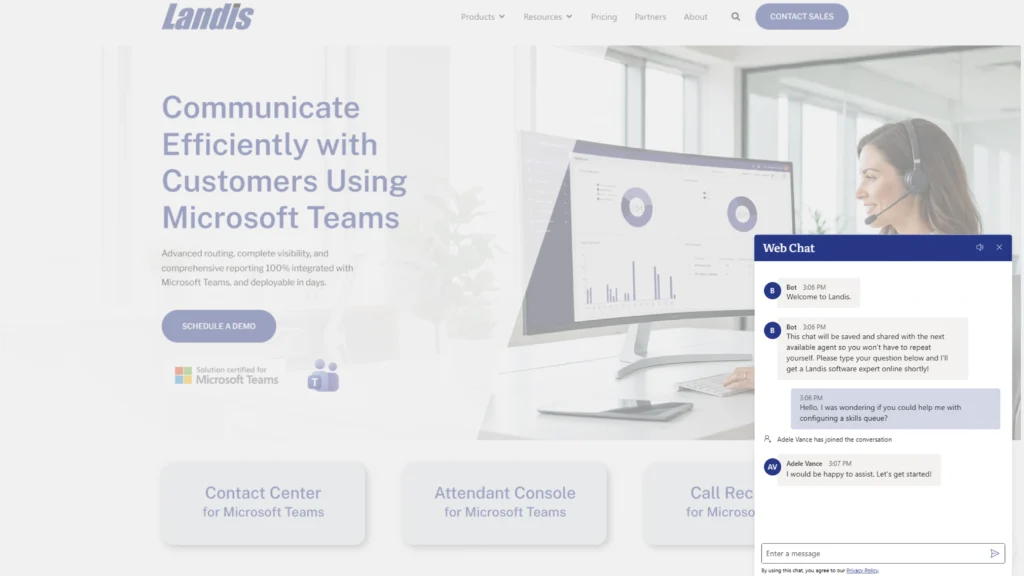
- Landis: Supports voice, Teams chat, web chat, WhatsApp, Facebook, SMS, and RCS..
- Voca: Supports voice, email, SMS, and web chat..
Administration and usability
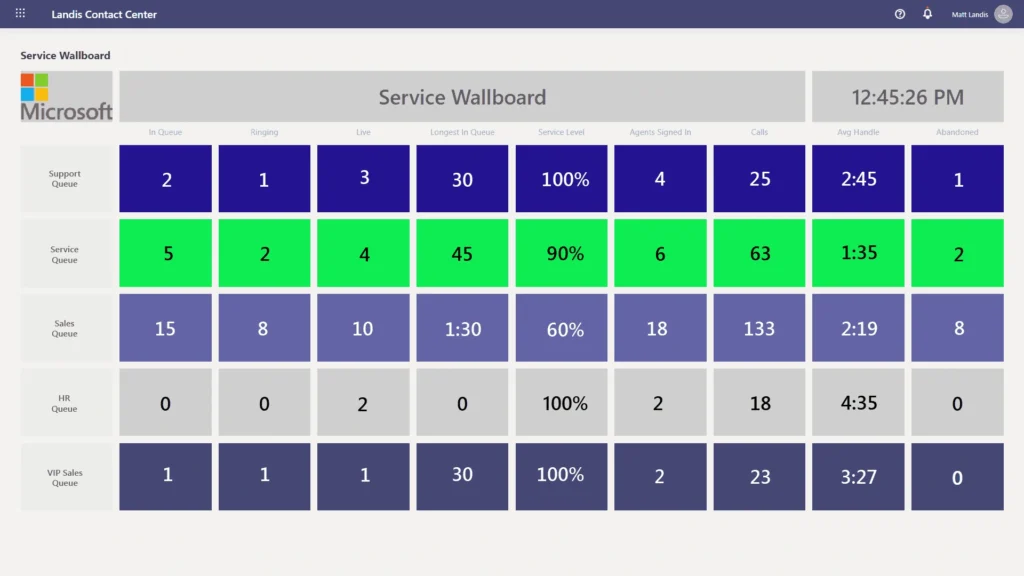
- Landis: Designed around ease of use. It offers intuitive agent controls, live wallboards, real-time alerts, and rapid setup. For agile teams or IT-light organizations, that simplicity is a major advantage.
- Voca: Provides a more advanced admin and supervisor experience. It includes multi-tenant controls, real-time re-skilling, and deeper queue management tools when you introduce an SBC.
Reporting and analytics
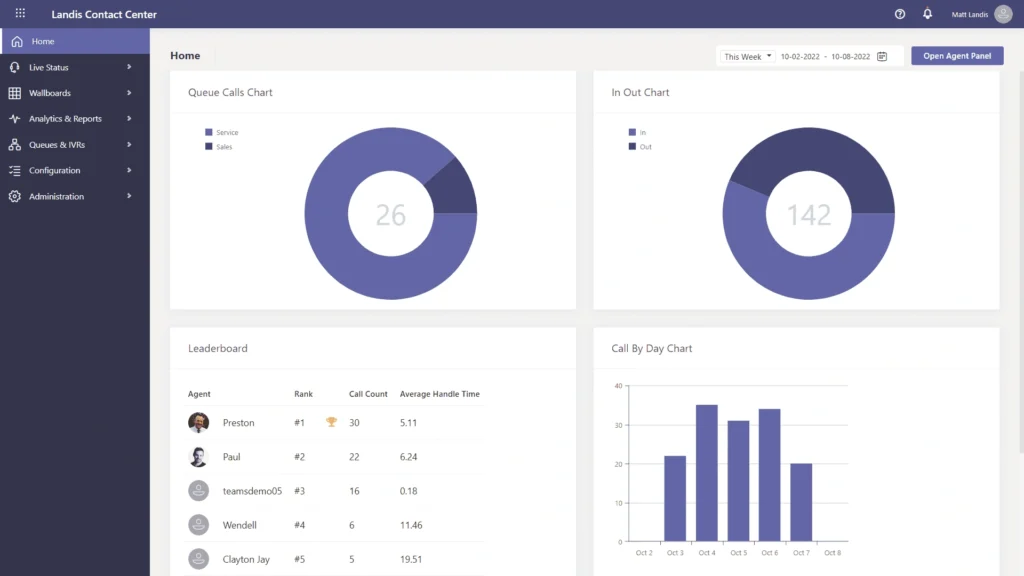
- Landis: Includes live dashboards, historical reporting, queue metrics, and sentiment visibility inside Teams. It’s built for immediate operational insight but can be developed into deep analytics when needed.
- Voca: Offers configurable real-time and historical analytics. It also brings rich conversation intelligence from transcripts and AI-generated insights.
Deployment and scale
- Landis: Cloud-based and optimized for rapid deployment. It suits small to mid-sized environments particularly well. That said, its strength is speed and simplicity, transforming the pace of change in large organizations that are moving to cloud-first.
- Voca: Also cloud-native. It’s built for enterprise-scale needs, including high availability and survivability options. That makes it a good fit for large organizations, regulated sectors, or businesses that need more resilience built in.
Pricing model
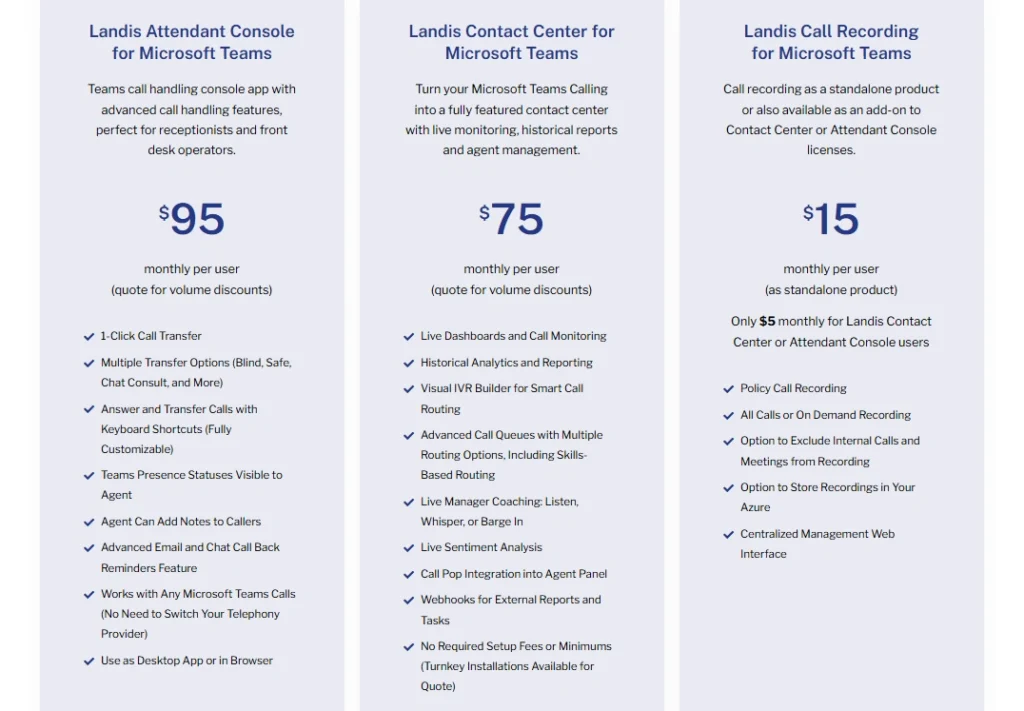
- Landis: Uses a flat per-user pricing model. That makes costs easy to understand and budget for. It appeals to organizations that want transparent licensing without usage-based surprises.
- Voca: Uses a concurrent channel model. This can be more efficient where not all agents are active at once. However, the trade-off is that pricing is less transparent and usually more customized.
Which wins where?
- Landis: Wins on simplicity, speed of deployment, and keeping everything inside Microsoft Teams. It’s the more natural choice for organizations that want a focused contact center without extra operational overhead.
- Voca: Wins on omnichannel depth, supporting email for a number of years whereas Landis is slated for Q4 2026/Q1 2027. It is the better fit for buyers who want more than a contact center inside Teams and need a broader communications platform, therefore is rarely a good fit for small to medium businesses.
Customer Reviews
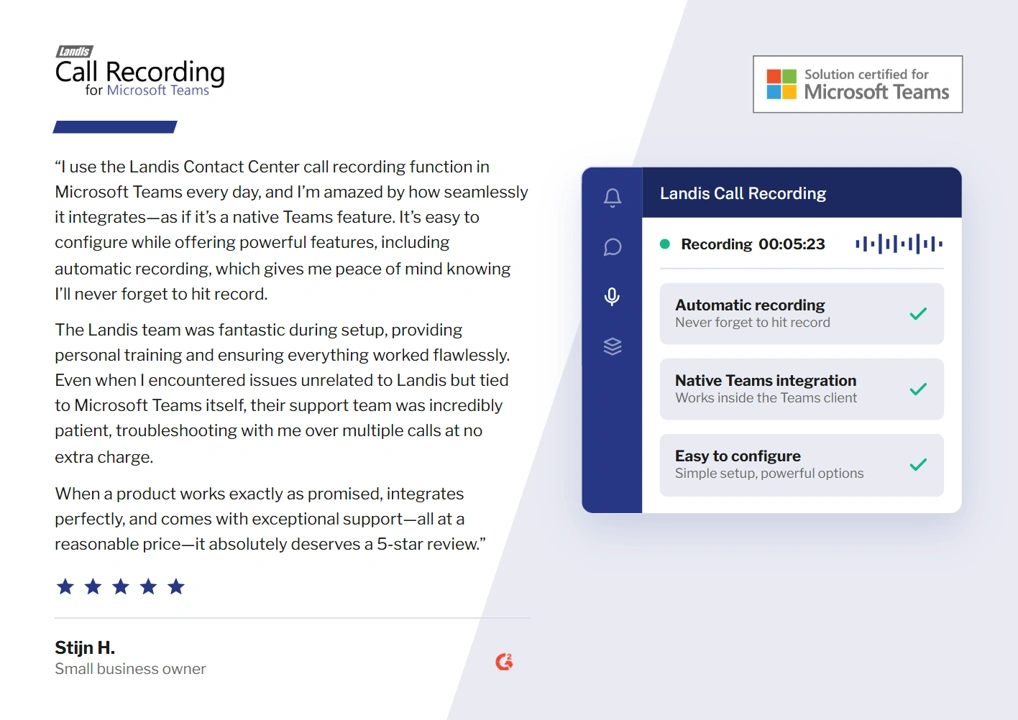
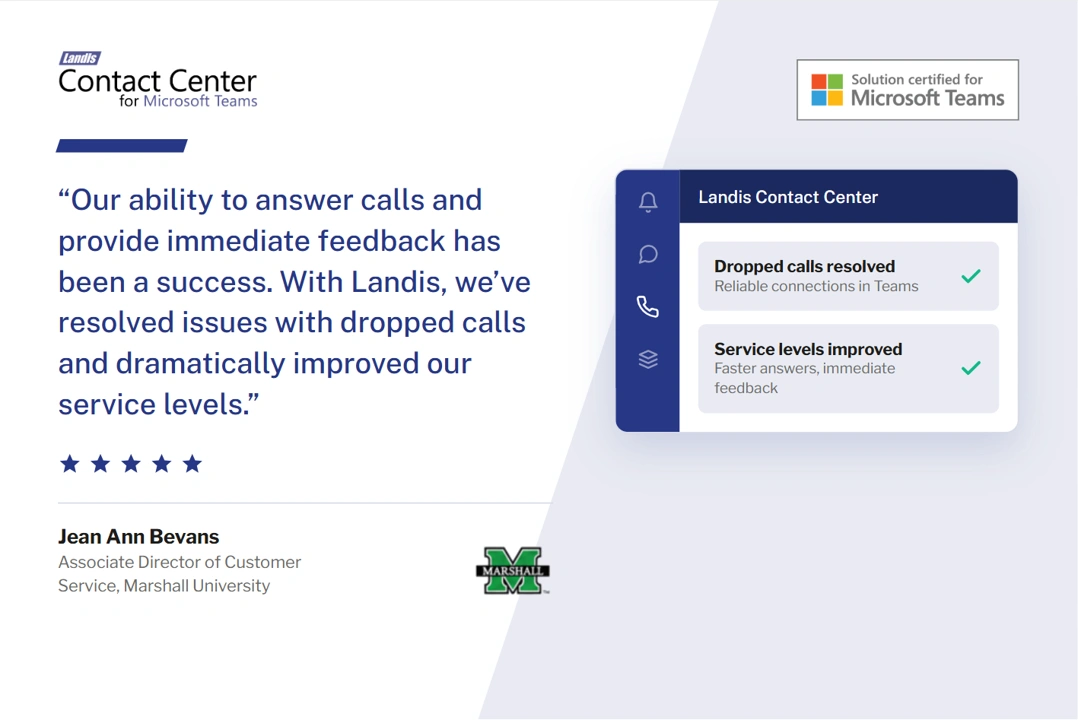
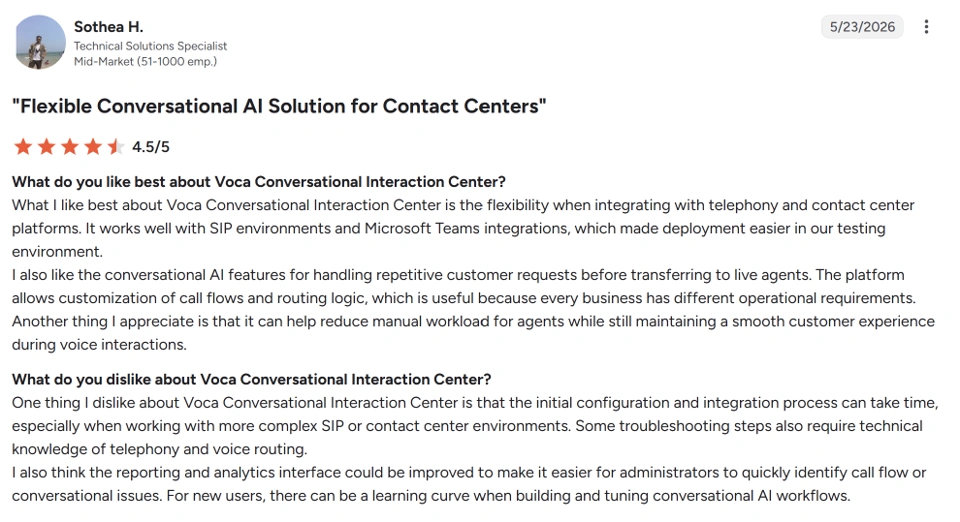
While it’s important to get first hand reviews from customers in your specific industry, I thought it pertinent to include a general consensus from review forums and case studies.
The goal here is to help build the bigger picture. Of course, both companies strive for success and internal case studies are favorable. Here are a few snippets from both sites and independent review sites.
Conclusion: Is Landis Contact Center Better than Audiocodes Voca?
Both Landis Contact Center and AudioCodes Voca are strong Microsoft Teams contact center solutions, but they are built with different priorities in mind.
Landis is the better fit for organizations that want a purpose-built Teams-native platform with a strong focus on simplicity, fast deployment, and ease of use.
AudioCodes Voca may be a more suitable option for buyers who need deeper AI capabilities, broader omnichannel support, and a more enterprise-oriented communications stack.
In the end, the right choice comes down to whether you value focused simplicity or broader platform depth.
For Teams-first organizations that want a streamlined contact center experience, Landis has a clear advantage. For enterprises that want more automation, and more room to scale, AudioCodes Voca is the stronger contender.
Ready to see a Microsoft Teams contact center built for speed, simplicity, and customer experience?